“Competition is for losers…so don’t focus on competitors”
People love to share this advice – and why wouldn’t they? It’s cute; it’s tweetable; and it calms the anxiety center of your lizard brain every time a customer asks you about a competitor.
Yet, it’s also the dumbest piece of business advice I’ve ever heard.
And that’s saying a lot.
Proponents of “don’t focus on competitors” have two core arguments – a dumb one and a smart one (that’s still wrong).
The dumb argument is that, “your customer is all that matters, so you should focus on them, not your competitors.” This argument’s well-intentioned, but outdated. Two decades ago your customers weren’t really aware of your competitors and finding products for their problems, let alone multiple competing products, was difficult. Ads were new (and definitely not targeted) and we didn’t write content, so information was siloed.
Put more simply – your customer used to be ignorant of what was in the market and had few ways to get educated, so you could take advantage of them (intentionally or unintentionally).
That’s all changed though.
Today customers can easily search for dozens of solutions to problems and we bombard them with targeted ads. So now your customers are either aware of your competitors or can easily become aware of them. In fact, we studied 11.2k decision markers for household and corporate budgets and found they look at an average of 3.2 products before making a purchase. That’s almost triple what it was a little over a decade ago. Therefore, if your customers care (or will care) about your competitors, you need to care about them, too.

That leaves us with the smart argument for “don’t focus on competitors”. I call it the “Peter Thiel” argument, because it was popularized by the famous PayPal founder.
Thiel essentially argues that winning entrepreneurs build 10x better products in new markets where they can establish a monopoly. Their monopoly gives them the freedom to ignore competitors. The rest of us are losers.
Like most smarty pants theories, it’s 100% right. If you can build a 10x better product in a new market to establish a monopoly, you should stop reading and go do that. Build the next Google. Go. Yet, that’s probably one of you – not 1 out of 100 of you – one of you.
For the rest of us, Thiel’s advice is behind the times, because building a 10x better product isn’t possible anymore. I know that’s triggering to some of you and your Elon Musk complex, so hear me out:
The barriers to building stuff – software, consumer products, media, etc – no longer exist. That fancy app feature can be ripped off in months, not years. Those special DTC ingredients; the factory will sell them to anyone. So if you don’t have patentable, hard science breakthroughs or regulatory protection, you won’t have a 10x better product (or at least one that’s 10x for long).
Competition is now permanent. If you Ignore your competitors, you’ll fail to defend your flank from attacks. You’ll also miss out on one of the best channels for siphoning revenue from them to you. Don’t believe me? You know your boy brings the data. In research looking at 3.2k companies, those who had competitive programs had:
- 23.7% lower customer acquisition costs
- 18.9% higher customer lifetime value
- 15.4% higher customer satisfaction
I like those gains. I’m assuming you will, too. They’re also why I designed a comprehensive competitive intelligence program that I used to fuel my company ProfitWell to an exit of over $200M. It gave us extreme leverage, which we needed since we were bootstrapped. It also tanked several of our competitors’ funding rounds.
The program combines playbooks from companies at the cutting edge of competitive intelligence programs with the training I received as an intelligence analyst fellow at the NSA while hunting bad guys and gals.
So here’s what we’re going to do:
First, I’m going to give you the proper framework of how to think about competitors in your space. The framework automatically uses data to determine who your competitors are, how much you should care about them, and what you should do with each.
Next, I’m going to give you everything you need – email copy, survey copy, VA instructions, calculators, templates – literally everything in order to create your version of the framework and then monitor these competitors for and hour per month (or quarter).
Finally, I’m going to give you the thirteen playbooks I use (and have seen others use) to attack and defend themselves from competitors.
This’ll be the last guide you’ll ever need for competitive intelligence.
You pumped?
Oh and one more thing – it’s free.
Let’s go.
What’s the Goal of a Competitive Intelligence Program?
So what in God’s name is a competitive intelligence program and what does it do?
Good question.
To some of you, competitive intelligence (and research in general) feels like a waste of time. You do a bunch of work, get some data, and then only 5% of it’s immediately actionable, so you decry the effort as too costly.
You’re also probably scared to do research, because you deal with a lot of Darrens and Karens at work. Karen asks stuff like, “is 104 responses statistically significant?” (without knowing that’s the wrong question). Darren likes to go on tirades about “Steve jobs using just his instincts to innovate” (even though Apple spends hundreds of millions on research every year). If your research effort doesn’t have an immediate payoff, then why do it in the first place?
Here’s the issue: you (and Karen/Darren) are thinking about research completely incorrectly.
Immediate, precise action directly from research isn’t the goal. As my mentor at NSA once told me, “intelligence is upstream of action.” Your goal with research is to build judgment. With every morsel of intelligence you’re training your instincts, so when you do take action, you make infinitely better choices and you make those choices quicker.
When you find out a terrorist is about to attack, you don’t want to spend precious hours trying to figure out how they think and what they’ve done in the past. You just want to know. You want enough judgement to respond swiftly and in the right manner.
Business is extraordinary similar (albeit less deadly thankfully). Your entire mission as an operator is to understand your customer and the market that seeks them as a customer better than anyone else. You cannot build that judgement quickly without research, especially on your competitors.
When you don’t, competitors sneak up and overtake you. MySpace dominated the social media market until Facebook – the company they thought “was just some college kid’s toy” – used the college niche to destroy them. Blockbuster knew exactly how quickly Netflix was growing and had all the money in the world to build a competing product, but didn’t counter attack until it was too late. At ProfitWell, we attacked our incumbent competitors for years without any of them putting up a defense.
None of these products were 10x better. None of them had secret technology. The incumbents had so much more money than the competitors, and could have maintained their dominance. Yet, hubris and a lack of understanding of their market cost them everything.

But wait – you’re not a giant company (yet) facing extinction, so what’s this got to do with you?
Competitive intelligence is essential to your existence at every stage. Your customers consider your competitors and and use them, so you need to care about them.
When you properly implement a Competitive Intelligence Program you know know who to attack and who’s attacks to defend. You end up learning more about your market and customer than anyone else. That knowledge leads to more revenue, lower costs, and infinitely better products.
You may nod your head at all of the above and still feel an emotional drag. You’re an executive. Caring about what a competitor’s doing feels weird, even if it logically makes sense. That feeling’s hubris though. It’s the same feeling that lead those incumbents to get destroyed by lesser competitors. We all share this hubris. It stems from a level of undeserved confidence, because we needed a coping mechanism to overcome the doubt and fear of failure.
It’s understandable.
Yet, do not be arrogant enough to think you will know better than your market. Be humble enough to always assume you can learn more, and your greatest avenue to that is customer and competitive research.
So all that being said – what the actual heck is a competitor intelligence program?
I’ll stop trying to get your buy-in and we’ll transition to giving you the meat.
A competitive intelligence program (even the government’s) has three parts:
- Target Identification: which competitors should you care about and how much should you care about them.
- Intelligence Monitoring and Extraction: monitor the proper competitors with automatic intelligence collection and targeted extraction campaigns.
- Operationalize Intelligence with Playbooks: use intelligence to attack and defend the right competitors in the right manner at the right time.
When done right, all three of these parts are automated and sourcing you competitive research consistently. You sit back and consumer that research to build your judgment. You see what appears to be working and what trends are shifting. With that judgment you make better decisions and implement playbooks that drive to your ultimate goal – more customers and more revenue.
I’m going to give you everything you need to run your whole program (for free) in as little as 1-2 hours of your time per month. Before we get to that though, I need to teach you the right way to think about your competitors in your market’s competitive landscape. You likely haven’t seen it before.
How to Think About Competitors
When you pay a business professor $150k to teach you about competitive strategy in an MBA program, they typically start with some variation of, “there are four types of competitors” – direct, indirect, potential, and substitutes.

They’ll then tell you the best way to determine your competitors is to think about each category of competitor and use Google and social media to come up with companies and products to put in each. Your job is to then come up with a “strategy” for each set of competitors.
While well intentioned and useful on a banal level this is closer to business masturbation than high output operations.
It’s the type of approach that creates a pretty presentation that receives lots of “great work” DMs and slack emojis before being put out to the cloud storage sea like all those other “strategy” presentations.
But why does it stink so much?
The reason’s important.
The above competitor categories focus on your view of the market. Here’s the problem though- your view doesn’t matter. It’s riddled with bias. If I ask you or ten of your executive friends who their top five competitors are, I bet most of my net worth the answers will eerily overlap with the five companies most mentioned in board meetings, team all hands, and sales calls.
This is natural, and it’s not that these companies aren’t competitors. Yet, we tend to raise the importance of a competitor to the level of our anxiety, not reality. Instead, we need a competitor framework that centers on the customer view of the market.
Who are your competitors?
Whichever companies your customers think about or can easily find when they think of needing your product.
How much should you care about each competitor?
To the level of their resources and marketshare relative to you and the rest of the market.
It doesn’t matter if they’re direct, indirect, or whatever; what matters is how much your customer cares about them. Given that principle, the framework you should use to properly map your customers is the Market Command Matrix. It maps your competitors on the only axes that truly matter – Market Mindshare (eg. how aware are customers of the competitor) and Resource Strength (eg. how much money is the competitor dedicating to the market).
Let’s walk through these axes in a bit more detail.

Market Mindshare
Market Mindshare is the level of awareness each competitor has in the market proportional to one another. That company customers instantly think of when thinking about a product (eg. “Google” and the search industry) – high mindshare. The hot new startup with $500M in funding, but no one has ever heard of – low mindshare.

Most importantly we’re mapping each competitor’s Market Mindshare by collecting data directly from customers (more on how to do this automatically later). They’re the ultimate arbiter of which competitors are important. By measuring their view we’ll know who to attack to siphon the most revenue and who to ignore, because they’re not worth our time.
Resource Strength
Apart from mindshare, we also need to understand each competitor’s Resource Strength – how many resources they’re dedicating to winning the market. That company who’s 10x bigger than you and has raised more money than God – high resource strength. The indie hacker who built a product over the weekend – low resource strength.

Resource Strength is a proxy of how much a competitor actually cares about the market. That level of care translates to who you’ll have to keep your eye on the most, because they can point those resources at you anytime they wish or are more likely to respond to one of your attacks. All of these folks we’ll monitor automatically with the tools we built out for you below. You may also need the defensive playbooks we’ll walk through, too.
Using Your Market Command Matrix
As I’ve been teasing a bit already, when you combine these two variables something powerful happens. You get an exceptionally pragmatic map of the market that guides you on what to do exactly with each competitor.

That competitor with high Market Mindshare and no resources dedicated to your market – go all out attacking them by trying to partner, because you’ll harvest a lot of customers quickly.
That competitor who complains about you a lot on social media, but no one uses – stop wasting your team’s time talking about his posts.
As you’re building, you only have so many resources. You need to spend them wisely. The magic of the Market Command Matrix is each section clearly shows you how to treat the competitors within them.
Competitors to All Out Attack

Competitors with high Market Mindshare and Resource Strength are high leverage for you, because these competitors will attack you and have lots of customers for you to steal, so you need to focus on them.
We’ll go through all the playbooks to use for these competitors (all for free below), but the overall gist is each of them will need comparison pages, sales battlecards, marketing campaigns, and partnership resources. They’re also the folks you’ll run your Wedge Strategy on.
Competitors to Just Monitor

These competitors have a good amount of resources dedicated to your space, but not much mindshare. They typically come in two ironically opposing flavors – either companies that are slowly losing in the market (incumbents) or new, well funded companies that are gaining Market MindShare.
Since they don’t have as much market share, but still could pose a threat with their resources, we want to monitor them until they’re worth our time and resources (eg. cross into the “All Out Attack” quadrant).
Competitors to Harvest

Competitors here are typically broad solutions that happen to be used to solve the problem your product solves. For instance, people use Microsoft Excel or Google Sheets for property management, but presumably they’d be so much happier with a software product purpose built for property management like Appfolio or Buildium. Microsoft and Google also don’t care about the property management market specifically, because their products are purposefully broad.
This mismatch is an enormous opportunity for you to harvest customers from these competitors, because presumably your product is much better for solving their problems than the “good enough”, broad solution. All playbooks (which we’ll share) should focus on creating doubt in the mind of the customer and making it easy to onboard to your solution.
Competitors to Ignore

Few people seem to use or have heard of these competitors and they don’t have a ton of resources dedicated to your market. They’re not worth your time, so ignore them. If that happens to change over time, you’ll be alerted through the monitoring playbooks we’ll go through in a bit.
Like all good frameworks, the Market Command Matrix focuses on action. We’re not just labeling who could be a competitor we should worry about. We’re identifying who is a competitor we should worry about and which playbooks we should use on them (which we’ll go through in a bit).
You’re probably thinking, “sure, but this seems like a lot of work and where’s the action to make me money?”
I got you.
We’re going to walk through how to create your own Market Command Matrix automatically. It’s the first step of building your competitive intelligence program. We’ll then give you all the playbooks to take action for each competitor in each quadrants.
Let’s roll.
The High Output Competitive Intelligence Program
The ultimate aim of any intelligence program is to make gains of any kind from your competitor while protecting yourself from any competitor attacks. For the US Intelligence community, those attacks and defenses optimize for maximizing security of all kinds. Whether it’s working to identify a terrorist cell and dismantling it before an attack even occurs or discovering the strengths and weaknesses of a trading partner before a negotiation, intelligence is the key.
For your business, those attacks and defenses optimize for revenue. Thankfully this makes your competitive intelligence program infinitely easier than that of a nation.
I had the honor of learning how the greatest intelligence community in the world works when I hunted targets for the NSA. I used those same frameworks and tactics to build a high growth company in an incredibly competitive space.
I’m not able to tell you specifically how the inside of the IC works (or I’d have to kill you ;)), but the Competitive Intelligence Program we built out for you takes a lot from my experiences. We then combined those lessons with 500+ hours of research on what the best companies in the world are doing when it comes to competitive strategy.
We’re about to walk through the whole program. It’s got three parts, and each part has a lot of free tools we built for you. Our goal is to give you everything you need to run your entire competitive intelligence program for 1-2 hours per month (or quarter). Seriously.
Let me say that differently – you’re about to have the keys to an engine that will boost revenue, control costs, and give you the ability to understand your market better than anyone else – for 1-2 hours of your time per month (or quarter). It’s also free.
To achieve this we wrote a ton of instructions that you’ll hand off to an assistant or team member and automated a lot of the steps. Some of that content isn’t exactly exciting and may slip into feeling a bit like an “instruction manual.” To curb that feeling, we hid a lot of details behind toggles or pushed them to your shiny new Competitor Command Center (more on what that is in a second). Basically, we’re going to make you a bunch of money and did most of the work for you, so don’t please complain if some of the details we built for you and your team aren’t riveting.
Cool?
Cool.
Let’s keep moving.
Any Competitor Intelligence Program (even the US government’s) has three main parts:
- Reconnaissance – Identifying your competitors: Who exactly are your competitors? Here we’ll answer that questions by automatically creating your market’s Market Command Matrix. From there you’ll know exactly who to worry about, spend time on, and ignore.
- Monitoring and Extracting Intel: Once we know who we should be tracking, we need a system for collecting research and intelligence on those competitors. Monitoring these competitors builds your judgment and market instincts to properly deploy the playbooks for siphoning revenue from your competitors.
- Intelligence Operations – Playbooks to Attack and Defend: Knowing who to track and monitoring them is just the first piece of the puzzle. Now we need to deploy our revenue playbooks at the right time. We’ll walk through thirteen of them.

To make running each part of your Competitive Intelligence Program easy we built out three core tools for you. They’re all free, and contain all of the instructions, calculators, copy, etc. we put together – basically anything you’ll need.
As we walk through each part of your competitor program, we’ll reference these and go deeper on their relevant parts, but here’s a quick overview of each:
Competitor Command Center

The Competitor Command Center is the hub for all your competitor intelligence – all the research, data, findings, etc on each of your competitors. It also contains every automation and instruction that your assistant or team member will use.
We built it out to make everyone’s lives as easy as possible. The only work you will personally need to do is to fill out the “Settings and Instructions” tab. It’ll take 20-30 minutes and then the sheet automatically adjusts all the instructions for your assistant or team member. They’ll then go off and do the rest of the work. We’ll go through more details on their pieces in a bit.
Given this is your hub for the competitor program, we recommend not sharing this with a wider audience. Keep it to you, the team using the finer details, and the assistant or team member doing the legwork.
Market Intelligence Stakeholder Deck

Once your Competitor Command Center starts spitting out awesome insights, we need your executive team, board, and company as a whole to use them beyond the competitive playbooks we’ll walk through below. We also want to wow them with your work, so we created a Market Intelligence Stakeholder Deck for you.
This deck provides an overview of the competitor and market intelligence you’ll collect (more on that in a beat). It automatically updates every time your assistant or team member refreshes the data in the Competitor Command Center. You can then send the deck with a note to these stakeholder groups to keep them in the know. We’ve drafted a message for you to use and more context below.
Your Guide to Competitor Intelligence
Your assistant or team member may need more context as they evolve your Competitor Intelligence Program. Your executive team may want more context on how to use the intelligence you’re gathering. To help, this guide you’re reading right now is your third resource. It’ll be updated over time with new playbooks and answers to any common questions that come up.
I did say we’d make your life easy, right? 🙂
Now it’s time to jump fully in to the first part of your Competitor Intelligence Program – identifying who the heck are your actual competitors.
Part 1: Reconnaissance – Identifying your competitors
When Rear Admiral Roscoe H. Hillenkoetter took over as CIA’s first ever director, he had a similar problem as you do right now – who are the “enemies” on your initial list of targets? You actually have a harder job than Roscoe, because at least he could choose from a finite number of nations on a map. Your competitors come from many different directions.
To warm up this cold start problem though, we can learn a lot from his initial approach. He began his efforts to map his competition with a “global sweep” where he cast a wide, indiscriminate net across foreign media, diplomatic communications, and early spy briefs. We’re going to do something similar within our market using the best army of spies a business can get – your customers and prospects. They’re the ones actually looking for a solution, from you or your competitor, so they’re the best folks to understand the market.
We’re going to use them to build out our Market Command Matrix.
How?
Well, if your customers are the perfect spies to understand your competitors, because they’re the ones using them and their view is the only one we care about, why don’t we just ask them?
That’s exactly what we’re going to do through a survey.
Wait.
Don’t leave.
I know what you’re thinking – “a survey? People hate surveys! They suck so much.”
We only hate surveys, because we suck at sending surveys, so we receive a lot of crappy, poorly thought out surveys that waste our time. Surveys are actually a phenomenal tool to get credible data when done properly, because they go right to the source (your customer) and extract intelligence when you use the right questions. Thankfully we sent over ten million of them via our pricing product, so we learned a ton on how to do them right.

We made this so easy for you. We built out the survey and email copy you’ll send, as well as a spreadsheet calculator for the survey results. You just plop them in and your Market Command Matrix automatically gets built. It’s not magic, but it’s pretty close. It’ll even automatically put your matrix right into that pretty slide deck we built for you, so you can confidently present your research to your team.
All the instructions are below (and in your Competitor Command Center), so putting this together should be a piece of cake. Yet if for some reason, you still don’t want to do the work, complete Step A below and skip to Part 2: Monitoring and Extracting Intel of this guide. You’ll miss out on a lot of insight and your confidence in running your competitive program will be lower. But, I don’t want perfection to be the enemy of progress. At the very least, read through the steps to see how easy it is – cool? Cool.
Let’s walk through the three steps to conduct your global sweep and then talk through how to interpret your built out Market Command Matrix.
Conducting Your Global Sweep
To conduct your global sweep you’re going to: A. input initial market information in your Competitor Command Center, B. send a survey using the copy and email we built for you, and C. paste the results into a tab in the Competitor Command Center, which will automatically calculate and produce your Market Command Matrix.
Most of the work is done completely for you. Step A will take you only ~ 30 minutes. Your assistant or team member will then handle Steps B and C using the instructions and tools we built out for them. There workload should only take a couple of hours max since we designed everything to be as easy as possible.
At scale I run these global sweeps on a quarterly basis (especially since they’re so automated). Markets tend to shift this quickly. If you’re just starting off though, I’d run your global sweep once every six months and then ramp up from there. A few of you only need to run once per year, but we’ll talk about if you’re that person when we chat through interpreting your Market Command Matrix.
Once you’ve completely each step your matrix will tell you exactly how your market’s shaped and seen from your customer’s perspective. We’ll then use that knowledge and other research to run playbooks to increase our revenue flow from those competitors.
Here’s a deeper dive on each step to running your global sweep:
Step A: Initial Market Information
The core of your global sweep involves sending a survey through an email. We could tell you which questions to use and how to write the perfect email like most guides. Yet, we’ve done this hundreds of times at this point, so why don’t we just do it for you?
All you need to do is fill out the “Settings and Instructions” tab in your Competitor Command Center. There we ask you some questions about your category, competitors, and preferences when it comes to conducting competitive research.
We then do some magic, and boom – you have your survey and questions.
There’s more though.
When you fill out this tab, we also take your inputs and create all the instructions to run the next part of the Competitive Intelligence Program – research and monitoring. With less than 30 minutes, nearly all the work you’ll need to do to setup not only your global sweep, but your entire program is done.
Pretty cool, right?
You sit back and use the data. We’ll do the rest.
Deeper Dive: Two “Settings and Instructions” inputs that are extra important
All of the inputs are crucial, but two in particular will setup most of the other instructions for doing your global sweep:
- Initial List of Competitors: Here you’re inputting up to 10 competitors that you’re thinking about (I recommend five max unless you’re a public company). Why are we doing this when I just wrote pages of why you’re biased? Well, you know something about your space and when we go talk to customers and prospects we’re going to ask them aided and unaided questions. For the aided ones, we need them to respond to a list.
- Your company category: This is a really critical piece of information, because your respondents are going to be responding to a question like, “when you think of YOUR CATEGORY, what’s the first product you think of?” I’ve included some examples in these instructions, but use whatever you’re currently using when answering “what’s your company do?”.
Step B: Conducting your global sweep
Once you’ve entered your inputs in the Setting and Instruction tab of the Competitor Command Center, we actually have to run the global sweep. Let’s walk through how we’re actually going to do that.
Remember we’re extracting intelligence from our perfect market spies – the market’s customers. They’re the ones who actually buy the products you and your competitors build. We just need to get into their heads in a way that limits bias. When we do, they’ll open up about which competitors they know, who they prefer and why, and they’ll even tell us exactly how to get them to convert from a competitor to you.
Sounds great, but also hard, right?
Don’t worry. There’s a secret.
At ProfitWell we sent millions of surveys that let us and our clients read customers’ minds. In the US Intelligence community thousands of people give valuable intelligence every day – even when they know they shouldn’t. In both contexts it all comes down to one thing – asking the right person the right question.
We already have the right person – your target customers. We go into more detail in the below toggle on precisely which target customers you should send your survey, but which questions are the right ones?
Deeper Dive: Who to target for your global sweep?
This is the single hardest piece of the entire Competitor Intelligence Program. Everything else is smooth sailing, but this one part we can’t do completely for you. I guess we could build an entire tool and give it away for free, but that’d be a company in and of itself, and I’ve got healthcare to go solve.
So what’s the hard part?
You need to put together a list of respondents to send your survey to, which will take effort. It doesn’t need to take a lot of effort and every time you send this survey it’ll get easier, because you’ll use the same list. Yet, there’s still some lifting here. I promise it’s worth it and we’ve worked to make it as easy as possible.
Here’s where I pull my email lists from to send competitive surveys – in order of easiest to hardest:
- Customers and prospects in your database: These folks are pretty easy for you to use, but you’re going to get bias in your dataset, because these folks are presumably already aware of you (prospects, less so). Yet, they’re better than nothing. At the very least, I would send your survey anonymously (more on this below) to limit bias.
- Market Panelists: Entire companies exist to get you in front of your target customer base to ask them questions and do research. Depending on your product, the cost will range from pennies per response (consumer products) to hundreds of dollars per response (Fortune 500 CIOs). The advantage to using these companies is you’re anonymous (so low bias results) and since you’re paying, you can add more questions you’re curious about, because you get more time with a respondent (15-60 minutes typically).
- Prospects outside your database: One clever way to build an email list for sending your survey is to use tools like BuiltWith, Zoominfo, Clearbit, et al. Here you pull a list of companies in your target market and then find the email addresses of the specific roles you target inside each company. This definitely isn’t compliant and I likely should’ve never done this, so run this playbook at your own risk. Today I’d just spend the money on market panelists, because it’s quicker and above board.
- Competitor Customers: Your competitors talk about their customers all the time, so another sourcing method is to pull all the logos from their website, case study pages, review sites, and social media. You then pull the emails of your target roles at these companies and add them to your research queue. Big note – Pulling these competitor logos is a part of the monitoring section, meaning your assistant or team member will do this work for you, so it may make sense to wait until the second or third time you send the survey to include them.
- Runnings Ads: If you don’t want to pay for market panelists or send cold email, then ads is another option. It takes longer, but you can do most of the targeting based on pulling these database lists and then driving people to the survey.
For the questions we need to get into how people think. We’re a highly suggestible species. It’s biological and stems from the fact we mostly learn via metaphor. When your ancestors saw someone die after eating certain berries, they survived by not eating those berries. That’s great for not dying, but terrible for trying to ask you a question that doesn’t immediately make you think of an answer (which I suppose is a worthy tradeoff).
For instance, if I ask you, “Is Coke the best soda?”, you’re automatically going to react in your head with “yes” or “no.” Your second thought will be something along the lines of, “which soda is better than Coke?”. My question, while well intentioned, has anchored your entire thought process around Coke, which makes it a crappy question for determining the best soda.
Here’s a better question: “what’s the best soda?” It’s a harder question for humans to answer, but that’s by design. You have to put in the work to think about soda, what makes the best soda, and then which sodas would fit that paradigm. By giving you space to formulate your answer we limit bias considerably, because we’re asking in an open ended manner.
In the market research world these open ended queries are called “unaided” questions. Questions where you give someone a few choices to choose from or something to react to are known as “aided” ones. We’ll use both in our global sweep, but the unaided question will carry most of the weight of our Market Mindshare score for our Market Command Matrix.
Check out the below toggle for the actual questions, but we also need to address one more piece – how do we position the survey to these customers?
Deeper Dive: Which questions will we use to extract intelligence from your target customers?
Approaching someone you want to get collect on requires careful consideration of what biases someone. If I ask you, “what do you think of Coke?”, you’re going to think about Coke and then Pepsi. Yet, if I ask you “what’s your favorite carbonated beverage?”, you have to come up with the answer.
These open ended questions are what’s called “unaided” questions. They’re a little harder for humans to answer than a multiple choice question, but giving us an answer without any prompting limits bias considerably.
Because of this our core question for mapping competitor Market Mindshare is:
- When you think of YOUR CATEGORY, what’s the first product that comes to mind?
The beauty of this question is it’s open ended nature will receive a wide variety of answers. Many will surprise you. Some will make you think the data’s wrong, because it’s easier to admit that then maybe you’re not as big or you’re close to a competitor you don’t like than you thought.
Remember we don’t care about what we think. We’re not seeking the answer you want. We’re seeking the truth. I’ve been in a couple dozen board rooms talking through Market Mindshare studies where executive teams are shocked by the results. The best ones go all-in on using the data to improve their spot in the market. The worst deny any validity, because it makes them feel insecure. Be the former.
We’ll also ask some “aided” questions to measure recognizability and usage. These questions give them different competitor names to choose from and their goal is to go deeper on the subset of competitors you’re currently thinking about:
- Which of the following YOUR CATEGORY companies are you familiar with? (multi-select from list)
- When you think of YOUR CATEGORY, what do you currently use? (select from list)
- How likely is it that you would recommend COMPANY CURRENTLY USE to a friend or colleague? (0 through 9)
- When you think of COMPANY CURRENTLY USE, what’s the most valuable? The least valuable? (List of core features).
That’s it. Those are all the questions. I promised it wouldn’t be too complicated.
With just five questions, we glean an enormous amount of insight. We’re able to build out our Market Command Matrix, as well as get signals on usage, recognizability, satifafaction, and even how competitors compare to one another. We’ll talk more on how to combine this data with other market data in a bit, as well as how to actually use the data in our competitive playbooks.
Just keep in mind – all you have to do is send the survey through an email (both of which were create for you). You’re probably wondering though – who’s going to receive this thing?
If we send a survey from your brand, obviously there’ll be some bias. If we tell a survey respondent we’re collecting this data to chart our path to market domination, there’ll obviously be bias, too. We’ll limit this bias by sending the survey in the right context.
Ideally this means we send the survey anonymously. When anonymous, we can control the context and messaging in a manner that gets us the best responses. They won’t know it’s us and we’ll make our email copy generic (eg. “we’re doing research on the marketing space”).
Two ways to achieve anonymity – 1. use market panelists (more on those in the “who to target…” deeper dive above), or 2. send from a domain you buy like marketingresearch.com (or something to do with your space). For the latter, you can still maintain compliance by listing your legal name in the footers, terms, etc, but most people won’t look there (which is what you want).
One other advantage to anonymity – you don’t tip off competitors. You may think I’m paranoid, but I don’t want to cede my competitor an inch in general. When it comes to this survey I also don’t want to give them fuel for marketing.
While building ProfitWell, we had a couple of competitors that were very vocal on social media. While some of their criticisms were valid, the way they engaged with valid or invalid criticism was often less than charitable. A survey like this would be good fodder for them, and I didn’t want to risk a public discussion.
When in doubt, use your best judgement and do what best aligns with your values. Either way, I’ve put a deeper dive on the exact copy for the email, as well as survey send best practices in the below toggle.
Deeper Dive: Global sweep email copy and survey send best practices
For getting the best response rates use plain text emails. After sending millions of surveys, we’ve found plain text gets roughly 30% higher response rates.
For your copy, we already wrote the email (and follow up) for you in this tab. The copy’s goal is to be intriguing enough to entice someone to take the survey without biasing them. You’ll notice a couple of ego traps to accomplish that aim. A version of this email’s been battle tested across a lot of survey sends, but feel free to edit as you see fit.
In terms of other quick hacks for sending survey emails:
- Send it early morning based on their time zone
- Send a bump 3 days after the initial send for folks who didn’t open (copy in the tab)
- Don’t use a raffle or prize to incentivize responses. It’s rarely effective unless you’re paying each individual respondent.
- Schedule a thank you message that gets shipped when someone completes the survey
From here assuming you filled out your “Settings and Instructions” tab your team member or assistant will bring you final copy and a survey link to conduct your global sweep. You’ll need to give them guidance on which target customers you’d like to target and any logistics for making that happen.
This is the hardest part of the whole Competitor Intelligence Program. That’s a good thing, because it’s really not that hard. We made it incredibly easy by doing most of the thinking and work for you. That’s a bad thing though, because you will have to put some effort in to get the results.
To help – remember what you’re getting with conducting your global sweep. You’ll have actual data to support where you and your competitors are in the market. We’ll then use that data to run our competitive playbooks that siphon revenue from your competitors to you. As an added bonus for conducting your global sweep and sending your survey, we’ll give you a little reward in Step C next. That’s where the real magic happens.
Step C: Building your Market Command Matrix automatically
Since you did the hardest part of the whole project, we thought it only fitting to reward you with some magical results. We could have told you how to do the math and let you wallow in spreadsheet purgatory, but that wouldn’t be very nice.
Instead we built out a whole calculator with a model I’ve iterated over dozens of studies for calculating Market Mindshare. You just plop your survey responses into this tab, and the calculator automatically cleans, calculates, and populates all the mindshare scores for your Market Command Matrix. It also spits out a bunch of insights on your Competitor Dashboard and Competitor Profiles, but more on those later.
To finish your Market Command Matrix, you then need to answer a couple of questions highlighted in yellow in the calculator tab. I’ve put a deeper dive toggle below on how to answer them, but they’re super simple.
Deeper Dive: Three quick decisions to finish your Market Command Matrix
To finish your Market Command Matrix, you’ll need to input three pieces of information in the calculator tab you pasted your survey data into:
- Do you want to override any Market Mindshare scores?
You shouldn’t need to, because these are based on a lot of iterations of looking at competitive data and we made the command center relatively universal, but we gave you the option. - Do you want to include Site Visit data?
Site Visit data is used as a measure of the ability to find a competitor even if the customer’s unaware of them. We’ve found it’s a really good proxy, because it measures how good a competitor is at getting traffic.
Your assistant or team member will collect this data in the monitoring section, so we recommend waiting to input this data until they complete their research. More on that in the next section, but when they put those data points into the tab, the Market Mindshare scores will update. - You need to input each company’s Resource Scores
One of the axes on our Market Command Matrix is Resource Strength, which measures the amount of resources each competitor has dedicated to your space.
When testing the Competitive Command Center for different industries, we found creating a universal model fairly difficult and not dramatically consequential to the matrix overall. In the spirit of keeping the project efficient, you’re going to score each competitor on 1 to 5 scale.
Don’t worry. It’s pretty easy.
You’re scoring the resources they have dedicated to winning your specific market, not against each other (or you). Your market’s #1 company likely has a lot of resources dedicated to your market (so a score of 5), whereas Excel likely doesn’t care about your industry specifically (so a score of 1).
A hack I like to use here is to score your company first and then the rest of the companies on the list in the context of you. If you’re HubSpot, you’re a 5, even compared to Salesforce (who’s also a 5). If you’re a startup that’s 6 months in, you’re a 1.
Don’t overthink it, and don’t worry about being perfectly precise. It’s subjective, but here are a couple of good rules:

And that’s it.
With one survey and a couple of questions you now know exactly how your market thinks of you and your competitors with your very own Market Command Matrix. You also gained a ton of insights into who customers use and how they think about them.
That’s cool – but how do we actually use the matrix?
Well Neo, we’re going to get into that in the monitoring and playbook sections where we’ll go deeper on how to use the research and data to siphon and protect revenue from your competitors. Before that though, let’s walk through how to think about your market depending on how you Market Command Matrix turned out.
Interpreting Your Market Command Matrix
Without collecting any additional competitive research, your matrix can tell you a lot about your market. You just need to look at it’s shape.
Is it super fragmented with no clear market leaders? Then you may not need to do much in terms of competitive playbooks, but you’ll need to accelerate your growth considerably to become the market leader.
What if there’s one big dog and a bunch of challengers? Then you’ll need to go all out and attack the big dog.
After looking at a bunch of Market Command Matrices over the years, there are four general shapes markets take:
Intensely Fragmented Market

In a fragmented market, there’s no clear winner, even if a number of competitors exist. If your market looks like this, it’s either really good news or really bad news. It’s good news if the market’s just nascent and no one’s been crowned the winner yet or the market’s just so freaking big no one’s pulled ahead yet. It’s bad news if the market’s just not worth much, which explains why no one’s winning, because there’s not enough money to make the market worth pursuing.
Capitalism is funny this way. It’s forces are undefeated in gobbling up value where it exists. If your market looks fragmented, you can use this principle to determine if you should continue to move forward or not.
I wish I would have run this analysis the first year of building ProfitWell, because this is how our market for subscription analytics looked. The market’s small. There’s only 150k target customers and the willingness to pay for analytics (of any kind) is crap. Obviously it all worked out, but it worked out despite our market. Doing this analysis would have saved us 18 months, because we either would have made our metrics product free sooner or we would have turned out resources to another product.
If you decide that your fragmented market is simply just nascent or so big no one’s winning yet, then keep going. You likely won’t have a need for a lot of competitive playbooks until your market matures, because there’s not enough juice to squeeze out of your competitors. I would still set up the monitoring program (the next part) with your closest rivals, but use the rest of your time going as quickly as humanly possible capturing market share and growing revenue.
Challenger Market

A challenger market has 1-2 big dog competitors that got way ahead early. They typically had a first mover advantage and no one caught up to them, because they had some innovation that couldn’t be replicated or no one realized the value of the market. Eventually those barriers fall though and a ton of competitors join the market.
If your matrix looks like a challenger market (and you’re not the big dog), most of your competitive playbook energy will go to attacking the 1-2 big dogs. You’ll have a huge advantage, because you don’t have to fight multiple competitive fronts and you can even partner with like sized competitors to take on the big dog together (more on this later).
Ancient Market

Ancient markets are my favorite, because they’re sleeping giants. Historically they’re full of multi-decade old incumbents in a boring industry that twenty something entrepreneurs don’t find exciting. Typically a number of companies have high market share, but so much of their traffic is direct or doesn’t require them to make much of an effort anymore that they aren’t spending a lot of resources on the market.
If you find one of these markets, go all in. Product innovation is typically stagnant, customer experience is normally crap, and many customers are ready for a “new thing to try.” This is because the incumbents haven’t really been challenged. If you innovate and provide new value, great companies can be created in these markets. From a competitive standpoint, you’ll use most of our Harvest playbooks below.
Mature Market

Mature markets are pretty standard for a market that’s been around for a bit. You’ll have numerous solutions throughout each quadrant. Valuable mature markets will be relatively dynamics with companies entering and leaving the market quite often. Less valuable markets tend to stay static over time.
If you’re in one of these markets, you should make sure to run all the playbooks. They’ll help you siphon revenue, but more importantly they’ll protect your revenue and overall marketshare as you grow. This is because most mature markets have less inertia given their high level of competition.
Other market shapes besides these four exist, but these are the main ones you’ll encounter. All markets have their tradeoffs for growth and you should run the global sweep at least every six months to see how your market’s shifting (and if your company’s improving). The matrix is a beautiful litmus test of progress, as it’s tapping into exaclty how your customers think.
Knowing where you and your competitors stand is obviously great, but we also need to use this knowledge to gain revenue with our competitive playbooks.
Before we get to running those, we have one more part to walkthrough – extracting more intelligence for the right list of competitors. We’re going to use the same workflow intelligence analysts use to understand targets. I promise you it’s less work than what we just went through, because we automated and outsourced most of the heavy lifting.
Part 2: Monitoring and Extracting Intel
The United States spends roughly $85B on the intelligence community every year (eg. CIA, NSA, DIA, et al). That’s about 1% of the government’s budget, and it’s not spent on what you think. Most of the budget isn’t for supporting the military or conducting James Bond-ian missions. It actually goes to monitoring and gathering intelligence on our allies and enemies.
You may think that’s a waste of resources, but think about this for a moment: what’s that budget bought over the years?
The US is the envy of the world and our planet’s one and only superpower. Your values may spark some puckering anxiety when reading that, but the numbers don’t lie. I personally have seen conflicts get stopped before they start or negotiations won – all because of intelligence. In any interaction with any institution or human in the world, we always have the upper hand, because we already possess or have the ability to quickly gain enough judgment on the parties involved.
That judgement then allows the US to act quickly and effectively.
You already know the importance of building your judgment. We do that through intelligence, which provides breadcrumbs of research and data about your primary target – your competitor’s customers. Those breadcrumbs tell us everything.
Revenue and growth trend breadcrumbs let us reverse engineer which competitor campaigns are working.
Customer product sentiment breadcrumbs tell us which competitor features are vulnerable for us to attack.
Job posting breadcrumbs tell us exactly what a competitor’s strategically prioritizing.
We study these breadcrumbs to find patterns. Those patterns develop instincts around how our customers and competitors think. These instincts then then inform the actions we take to convert those customers to our product.
Put more simply – gathering intelligence on your competitors gives you superpowers. With just one hour per month (or quarter), you’ll understand your market better than anyone. You’ll see exactly which competitors are growing and which are slowing. You’ll know the pulse of how customers view your market, so you’ll know exactly which messages move them from your competitor to you. As the layers of data build up over time, you’ll even see patterns emerge that your competitors could only dream of seeing.
You won’t be an oracle, but you’ll sure feel like one.
Most importantly though – you’ll make infinitely better decisions, especially when running competitive playbooks. Plus, it’ll be intensely fun, because you’ll focus on what’s most important – strategy.
Does that fire you up?
Good, but it seems like it’ll take a lot of work, right?
Wrong.
You won’t have to spend 1% of your budget. There are two components of your monitoring program: data collection and analysis. Data collection’s collecting the breadcrumbs. Analysis is reading and skimming the data for themes and trends.
You’re a business leader, so you don’t do the first part. Your time shouldn’t be spent sourcing and cleaning research. All your time should be spent on the second part. Knowing the market and making decisions based on that knowledge is how you earn your paycheck.
To make this happen we built an “ NSA in a box” for your company. Inside the box we take the competitors you need to monitor (those in the All Out Attack, Harvest, and Just Monitor sections of your Master Command Matrix), and put them in a system where your assistant or team member collects all the intelligence and research in 2-8 hours per month (or quarter). They’ll have all the instructions and tools they need.
That’s it. It’s that simple.
They use the tools we built to do the bulk of the work. You spend that one hour per month (or quarter) and then use the findings to implement the right playbooks to attack your competitors or defend from their attacks.
Let’s go deeper though, so you understand exactly how you’ll spend that hour, what research and data you’ll look at (and where), and what your assistant or team member’s process will look like each month (or quarter).
Your Intelligence Monitoring Workflow
To build judgment you need to track a target over time along axes that matter. For a terrorist you want to understand their routine and movements, close and continual contacts, and how they act and respond to other actions. For a competitor you want to understand how they see and position themselves in the market, if they’re growing and how, and how they respond to adversity. It’s as much about learning as it is about taking action against them.
Knowing these axes as a single point isn’t helpful. You need to string together many moments and data points over months or years. You then make predictions about what you think they’re going to do and check how often you’re right. As you hunt them, your profile gets better and better. That profile’s where you gain your leverage, because your increasingly better judgement allows you to use our attack or defense playbooks infinitely better.
All of that’s great, but what are you actually doing in that hour per month (or quarter)?
Most of your work takes place in your Judgment Log, a central document where you catalog your reactions as you review the research collected for you. Every month you’ll review the research that’s been collected for you and note any notable changes or themes for each competitor. You’ll then log those observations in your judgement log.
For each competitor’s research, you’ll answer:
- Did anything I predict last time turn out to be right? Wrong?
- What do they seem to be focused on? Has that changed?
- What do I think they’ll focus on or do next?
- Where do they seem strong? Weak?
- Did I have any notable conversations with people connected to them? What’d you learn from them?
When you do this oncer per month for six months (6 hours) or oncer per quarter for four quarters (4 hours), I guarantee you will understand your market better than anyone and make infinitely better decisions.
You will amaze your team.
You will amaze your investors.
You will amaze yourself.
Where does the research you’ll review live?
Your team or assistant is going to collect a ton of data and research for you using the tools and instructions we built out for them. To make your (and their) life easier though, we’ve curating all of the research into three places. You only need to read and skim these three assets, which is how we’re able to achieve you getting all the value out of a monitoring program in only and hour per month (or quarter).
We’ll go deeper into data that goes into these assets, but let’s walk through what they are and their purpose:
Your Market Intelligence Stakeholder Deck

This deck contains a high level summary of the research and data on your core competitors. You’ll see overall growth trends, customer product sentiment summaries, and how your competitors compare to one another on multiple axes.
The deck purpose’s is to give you (and your team) a pulse check on how the market’s shifting over time (if at all). You won’t find all the nitty, gritty details, because those can get distracting to your team.
When doing my monthly (or quarterly) review I look through the deck and note any themes or changes that seem to be happening. Are any competitors on an upswing or downswing (eg. someone just raised a massive funding round)? Has there been a big shift in customer sentiment (eg. a competitors review ranking dropped)? Is the market going up or down? Are there any new entrants?
After noting my thoughts in my Judgement Log, I then send a note to my board and executive team using the following copy:
Note to stakeholders on how the market’s shifted
Hey everyone – we’ve refreshed the Market Intelligence Deck. I’ve linked it here, but a couple of observations:
Things that have changed
- INSERT ANYTHING THAT’S NOTABLE AND CHANGED
Things that seem to be holding steady
- INSERT ANYTHING THAT’S NOTABLE AND CHANGED
Action items from this data
- INSERT ANY ACTION ITEMS
Your Competitor Dashboard and Profiles

After looking through the market intelligence deck, I review the Competitor Dashboard and Competitor Profile for each competitor.
These house all the nitty, gritty details about each competitor and the market as a whole. You’ll find data ranging from headcount, lifetime value, and NPS to tech stack, customer lists, and feature value output. In short – every detail that’s important to building judgment on your competitor exists in these profiles and dashboard.
You’ll use this data more in-depth for the playbooks, but when I’m reviewing it for my Judgement Log I’m looking for notable changes – did they land a new big customer? How’s NPS shifted? Things like that. I’m also looking at how competitors stack up to one another since all the data lives in the same place. I can easily see each competitor in the context of others – eg. two competitors seem to gaining the same amount of ground, because of a new feature that’s popped up in the review sentiments.
We’ll go more deeply into the specifics of this data in the next subsection.
Your Media Monitoring Labels

After looking at all the growth and trend data, we’ll review the key messages your competitors and their key employees are sending via Media Monitoring.
Here your assistant or team member set up an inbox label system to track every important message sent from and about your competitor. Marketing messages, podcast interviews, investor updates, CEO subtweets – everything’s ported to one place.
You’ll monitor these messages, because they’re the key to unlocking what your competitors are pushing onto the market. You can also see if those messages are resonating or not when comparing it to the growth trends in the Competitor Dashboard. For instance, a competitor may switch their marketing messaging to be about a particular feature, but after a few months that feature doesn’t show up in any customer reviews. This probably means the feature’s a dud and the competitor’s team either didn’t do their research or missed something.
You’ll note these observations in your Judgement Log and over time you’ll start to realize all things about your competitors – which have product teams misaligned with their marketing teams, which are really good at knowing what customers want, and even which seem to have the most disgruntled employees.
To recap – every month (or quarter) for an hour you’ll look through a deck, a dashboard, a profile for each competitor, and a few email inbox labels. You’ll then record your thoughts in a document. That’s it.
To make it this even easier, the the setup instructions your assistant or team member will run through will also trigger recurring calendar invites for you, so you don’t have to worry about remembering to review your research.
Try not to skip a cycle. It seems like you’re just learning and not doing. Yet, the hour you spend reviewing the research and filling out your Judgment Log is the highest leverage hour you’ll spend. You’re not just learning about your competitors. You’re learning about your customers and market. You’ll see what’s working (and not working), as well as how your market shifts. I can’t think of a better way for an operator to spend their time.
Of course, you’ll also use all this research and judgment to run your competitive playbooks. We’ll get to those, but let’s first walk through specifically what you’ll find in the research before explaining how your assistant or team member will collect everything automatically.
What intelligence will your team collect?
When monitoring and hunting targets you learn that every target has a goal, and the key to exploiting that target for your own means is understanding that goal. When you do the goal reveals why they’re doing what they’re doing, as well as helps you predict what they may do next. It also let’s you see if those efforts are working or not.
Knowing a target’s goal is tricky though. Goals have many layers and sometimes the target doesn’t even understand them. A terrorist may think their acting out of religious dedication, but in reality everything they do actually stems from the want of status within a community.
Analyzing the goal of a group’s even trickier. A government or group’s made up of many sub-groups that are all made up of many people. Every stratum may have different, and sometimes contradictory, goals that all aggregate into a particular direction.
Thankfully businesses aren’t that complicated.
Every businesses goal is to make money. Sure, the underlying goal of the people who work there may be different – building a good life, world domination, making the world a better place, etc. Yet, the core goal is still revenue.
The revenue goal makes collecting intelligence on our competitors supremely focused – we want to collect research and data that reveals what they’re attempting to do to drive revenue and then if it’s working. Think of these as inputs and outputs. For instance, a competitor may push a new marketing campaign that talks up their amazing support (an input). We can then see if any of their reviews or customer sentiments mention the support (an output). If not, we can determine the input didn’t do much and the input likely didn’t move the needle.
We’ve put together a comprehensive research program that tracks the right inputs and outputs for each competitor and puts them in your dashboard and profiles. All the work’s done for you. Your job’s (as we talked about already) is to skim and read the research for your Judgment Log and then use the data in our playbooks for attacking and defending.
You should still understand the specific data and research we’re collecting though. It comes in three categories. Let’s walk through each.
Outputs: Competitor Growth and Sentiment Trends
We don’t inherently care about our competitor’s companies specifically. We care about how customers and potential customers view these companies. Do they like the product? Which type of customers like the product most? Why? How’s that changing over time? Are they continuing to buy? Have they stopped?
In a sense you’re a detective trying to understand which aspects of these products resonate or don’t resonate with customers. Knowing these trends exposes where a competitor may be vulnerable or strong. We can then choose to steal or reject these aspects for our own products. We can also exploit these vulnerabilities with our playbooks.
To get these insights, your assistant or team member will track data like headcount, revenue, and site visits on a monthly (or quarterly) basis. They’ll also run sentiment analyses on customer and product reviews. We even gave them a script to pull competitor customer logos from multiple sources. All the instructions have been built out for you. You’ll just see the results in your Competitor Command Center. For a full list of data and research though, check out the deeper dive toggle below:
Deeper Dive: Which growth and sentiment trends will be collected each month (or quarter)?
Here are the trends your assistant or team member will pull for you on a monthly (or quarterly) basis:
- Core data
While we don’t care about a competitor company in and of itself, where they’re located, how much funding they have, who their investors are, and the like are all crucial to painting an image of their risk appetite and effort level. For instance, a San Francisco based competitor with $500M in funding who gains all their sales through paid media acts differently than a Boston based competitor with $100M in funding who gains all their sales through events and community. I’d fear attacking the latter more, because they had to gain more leverage with their funding than the former. Their customers are likely harder to steal, too. - Key People
Anyone you have or want to have a relationship with at the competitor company should be consciously listed out and tracked. These folks you’ll gain intelligence from directly and indirectly through conversations and tracking their public communications (interviews, Twitter, etc.). They’ll also be the folks you’ll want to build relationships with when it comes to M&A and partnerships (both of which are crucial in a competitive ecosystem). We’ll talk more about these relationships later. - Growth data
Knowing competitor growth is paramount. Headcount and site-visits are good proxies, but there are some obvious and non-obvious ways to also gather revenue and customer counts. Growth trends give you a picture of how the market’s being shaped (and your position in that journey). It tells you who’s vulnerable. It tells you who could kill you. It also allows you to know how and when to respond to different competitor actions. For instance, I’ve had success taking multiple like sized competitors and using the frustration they all have for the top dog in the market for joint marketing campaigns. - Customer and Product Sentiment
To siphon customers from competitors (and ensure you keep yours), you need to understand how customers perceive a competitor’s product. Sentiment data’s crucial to running any competitor sales and marketing campaigns. For instance, in building ProfitWell Metrics, we discovered quickly customers complained about accuracy amongst our competitors. We fixed our own accuracy and then made most of our competitive marketing about said accuracy. It was the highest ROI campaign we ever ran. - Customer Lists
A number of our playbooks target competitor customers specifically. To do that, you need to start building out a list. Some competitors customer lists are easy to find – using tools like Clearbit, BuiltWith, etc. Yet, all competitors expose a portion of their customers on their website via logos, testimonials, and case studies. Each month (or quarter) your assistant or team member will pull these logos and maintain a list of customers using your competitors. - Other Trends
Depending on your market, customer, or product there may be other relevant trends to track. I’ll go through this more in a bit, but if you fill out the “Settings and Instructions” tab, you’ll be prompted to add these trends to the list. They’ll be automatically added to the instructions for your assistant or team member.
Inputs: Competitor Media Monitoring
Trend and sentiment data is one half of the judgment puzzle. It shows you what actions worked (or didn’t) for a competitor in your market. The other half is going upstream of those results.
We need to understand what your competitors are pushing into the market. How are they trying to shape the world your customer sees? This is where monitoring your competitors media flow comes into play.
To do that we’re going to push every major and minor message your competitors’ stakeholders put out into the world into one place. Obviously their sales and marketing messages will tell us which themes they’re trying to push on the market. Yet, companies are oblivious to how much other rich intelligence they consciously spew (especially via their employees). Their job postings will tell us what they’re prioritizing. Their glassdoor reviews will tell us when they’ve shifted strategies. Even their key employees’ social media profiles will tell us how things are going.
We’re going to monitor everything each competitor is pushing on the market. We’ll then combine these findings with our growth and sentiment trends above to paint a complete picture of what your competitors are trying and if it’s working.
Functionally media monitoring sits in an inbox with each competitor’s messages and alerts going to an email label. During your Judgement Log hour you’ll simply click each label and review the messages that’ve come through, noting any themes or trends in your log. We’ll also use these findings in our playbooks.
Your assistant or team member will set your media monitoring up for you, but if you want a deeper dive of all the messages they’ll track for each competitor, check out the deeper dive toggle below.
Deeper Dive: Which messages will we track for each competitor?
Here are all the media sources we’re going to track for each competitor (and why they’re critical):
- Marketing, sales, and customer email lists
How your competitor communicates to the different parts of the funnel shows you exactly what they find important. Which features do they highlight? What value propositions? Do they seem to hammer any channels indicating that’s working for them?
My favorite is when what they think is important has nothing to do with what their customers find important (something you’ll find when doing your global sweep in Part 1 above), because that’s a mismatch we can exploit all day, every day. - Social media feeds
Companies never pay social media marketers enough (nor hire enough of them), so they slip up all the time and are a goldmine of high signal data.
We’re going to watch for posts that either reveal a bit too much (eg. talking about the goals of the company) and posts that are way too coordinated. The latter indicates that whatever they’re talking about is a high priority internally. For instance, if all of a sudden every post is about startups, indie hacking, and small businesses, it indicates they’re going down market. - Key employee social media feeds
If not for the revenue that comes from social media (and this small thing called free speech) I would not allow team members to use social media (myself included). They reveal so much. Junior employees say too much. Executives try to subtweet their ambitions. Disgruntled employees piss and moan passive aggressively. It’s amazing signal to build judgment. Even if none of that happens I can tell an amazing amount by when a consistent tweeter all of a sudden stops – 9 out of 10 times the company’s going through a bunch of pain. - Board member social media and email feeds
Most companies listen to their boards way too much, but their boards don’t listen to them. It’s not their faults. They have 10+ companies, so they speak in themes, telling each things like, “you need a PLG strategy” at the same time.
We can take advantage of this by understanding what their board members are sharing to social media and their email lists (if they have one). You know that message is going to the company, and at least half of companies will scramble to adjust and listen. It’s the wrong move, but it happens and you should watch out for it. This also works well for M&A. I used what one of our competitor’s board members were talking about to leverage into an acquisition conversation, because we would “fulfill that thing NAME keeps talking about.” - Google Alerts and Paid Media
Depending on your industry, knowing who’s talking about your competitor can be incredibly valuable, especially when seeing how they’re describing them. If they always seem to get bad press, I want to capitalize on that. Good press? I want to ride whatever wave they’re riding. Google Alerts let you somewhat efficiently set monitoring up across the web.
For some of you (consumer or e-commerce brands), you’ll also want to set up paid media monitoring. The way a company uses advertising is a huge signal, because it shows what’s working for them (aka what I’m going to steal). For both web monitoring and paid media monitoring there are great tools, but I’ve found the basics work pretty well unless you have a very specific need. - Job postings
Team members are “resources” at a company. When a company has a change in strategic plan, what do you think they do first, especially after annual planning? They align the job postings they need to the strategic plan, and you bet your bum I’m going to exploit the heck out of that.
I’m going to look for shifts in the descriptions over time, how many engineers they’re hiring, and the titles of any directors, VPs, or C-levels. With these I can ascertain how fast they’re moving and in which direction. We’ve built an AI prompt for analyzing priorities of job descriptions in the VA instructions below for you - Glassdoor reviews
Glassdoor is not a great signal of the quality of the company, but it’s an amazing treasure trove of what’s being talked about or struggled with internally. Angry employees do not care about NDAs or saying too much, and they say too much all the time.
I’m going to look for a lot of key words in these reviews. Things like “the strategy changes all the time and no one knows what’s going on” means management sucks. “The culture used to be fun” means they wait too long to fire people and likely had a layoff. Any complaints about snacks or fringe benefits means the mission is weakly communicated and they’re not moving quickly enough. We’ve built an AI prompt for analyzing these in the VA instructions.
Bonus: How to Turn and Use Human Assets
The core of your monitoring program is on data and research we can source from outside an organization. It’s all that’s truly necessary. Yet, if you want more specific insights or context, my favorite source are humans involved inside a competitor.
Employees (both former and current), investors, and partners give up the most prized information. This is because they’re humans, so they can tell you more in one conversation than you can learn from a dozen marketing emails or a growth trend.
As a side note, building these relationships is also just good practice. While building my company I went out of my way to meet and build relationships with our competitors. Some of these relationships never went anywhere. Others lead to co-marketing and partnerships. One in particular lead to our acquisition. You won’t know which ones will produce revenue, so I find a general willingness to be open to conversation a best practice.
To do that you don’t need a team of super spies either. You’re already monitoring their social media communications through your media monitoring. Now you just need to layer on 1:1 conversations with key stakeholders. You’re probably already doing some of these through general networking.
The shift from what you’re already doing comes in who you approach for conversations, how you approach them, and what you do after them. You’ll seek out specific people and look for specific insights throughout your conversations. You’ll then record their thoughts in your Judgement Log after you have them. Every conversation will lead to rich insights that’ll build your judgment in ways you just can’t get from anywhere else.
Since there’s so much value in developing human assets, let’s go a bit deeper here. Remember, this isn’t completely necessary, but if you’re a couple quarters into your Competitive Intelligence Program and want to start layering on advanced tactics, this is where I’d start.
To get a breakdown of my approach to identifying assets and having conversations that lead to interesting findings in the toggle below.
Deeper Dive: Identifying assets and tactics for conversations that lead to insights
My approach has two key parts:
- Identify important assets
Your assistant or team member will build out a list of the obvious key people for each competitor (leadership team, board, etc) when they run their research each month.
That being said, I like to look for people who actively or passively fill the following categories:- Employees as they’re leaving
Employees leaving a competitor tend to be pretty loose lipped, regardless of how good or bad their experience was at the company. You can turn on alerts for when folks leave jobs and reach out with some of the copy below to have a conversation. You won’t get everyone, but the conversations you do get will be very fruitful. - Investors
In general investors believe they are smarter than you about your market (a lot of times they are) and love to talk about what they know or found. I make a point to know the key board members and investors of each competitor. I then seek conversations with them at events or directly. You especially want to look out for investors who reach out to you asking about your space. 9 out of 10 times they’re looking to invest in one of your competitors and are trying to gain their own intel. I reverse these conversations by sowing as much doubt as possible about the space. - Partners
Partners are the best source of competitive intelligence you can find, because they don’t inherently care about you or your competitor. They care about their company who’s making money off both of you (hopefully). Over a zoom or coffee they’re more than willing to inadvertently tell you a whole bunch. - Customers who refuse to leave the product
You’ll come across customers who refuse to leave a competitor, because of some connection to someone who works at the company. Your instinct is to ignore them. That’s not right. These folks are amazingly useful, because when befriended, they’ll tell you all the wins and losses they’re having with the product. They won’t filter no matter how much you ask.
- Employees as they’re leaving
- Turning and developing assets
Once you’ve identified who’s worth chatting, gaining intelligence through conversations with them comes down to understanding their incentives. I don’t lie in these conversations and am upfront that I’m competing with the company their associated with, but I also don’t approach the conversations as, “tell me everything about the company.”
Instead, I approach these conversations through the following topics:- Commiseration about a third competitor or partner
In every space there’s either a top dog or a really annoying company in the market. Sometimes both. Sometimes multiple. I’ll talk to person at Company A about Company B and they’ll inevitably open up about their opinions about Company B. You may not think that’s useful, but what they’re really doing is revealing how they think about the market. If they say, “Company B’s wrong because X”, that means they believe in X. The key is to open them up and unfortunately people love to crap on others, especially if you’re both competing with them. - Industry shifts
Every market’s got big shifts that happen. Some are legal shifts that pit everyone against a governmental change. Others are technological shifts that lead every competitor to have to shift. Use these shifts to start conversations. A simple, “how are you guys thinking about X” will lead to help on X for your company, but also them revealing more about how they think and make decisions. People love to help or at the very least love to share new information they’ve learned through a struggle, so you can hop onto that energy to learn. - Trade notes
Depending on the target’s relationship with the competitor, “trading notes” is my favorite way to start conversations. Everyone has anxiety over you knowing something they don’t about your market, especially investors and partners. Having a specific ask – “how are you looking at this market” – opens the person up considerably, giving you insight that’s directly actionable, but also sparks a wider conversation where you can go deeper. Always keep in mind everyone is trying to learn more, so you can take advantage of that phenomenon. You’ll have to provide some learning, but you’ll get more than enough in return.
- Commiseration about a third competitor or partner
Keep in mind our goal is to continuously build judgment. Yet, when having these conversations you’re also trying to build relationships. You have absolutely no idea how these relationships will evolve. Some competitor employees will be phenomenal at your company. Some competitors will end up being great targets to acquire or will acquire you. Investors know everybody, so having a great relationship with them will typically pay dividends.
Said more explicitly – don’t be a jerk and don’t just take from these conversations. Make sure you give, too.
I always try to make sure I provide the person I’m speaking with knowledge they don’t know or a small favor in some way. I’ll refer people for jobs, make introductions, and even give feedback (when requested). If you get a reputation as someone who’s helpful, you’ll find all of the above becomes infinitely easier.
How are we going to automatically collect this research?
Ok. That seems like a lot. And it is.
Don’t worry though. We put together an entire system to collect all of the above for you. Remember, we want you to focus on the highest leverage part of your Competitor Intelligence Program – analyzing, building your judgment, and then implementing playbooks to attack your competitors and defend yourself from their attacks. We’ll take care of the rest.
To make that happen, we could have just told you how to set all this up. You’d likely never do it though. Instead we built out all the instructions for your assistant or team member to set all this up for you and for them to refresh the data on a monthly (or quarterly) basis.
The full instructions are in this Competitor Command Center tab, but here are the key steps you need to know as the key stakeholder:
- Fill out the Settings and Instructions tab
We explained this already, and you hopefully took the 30 minutes required to fill it out after reading Part 1. As a reminder, this tab is the only step you need to take to get your assistant or team member moving doing the rest of the work. In it you’ll make several important decisions about how you’d like the research conducted. - Set up Media Monitoring
To properly conduct media monitoring, you’ll have your assistant or team member use the Media Monitoring Setup Instructions found in their instructions tab. Through those instructions they’ll take an email address and sign up for messages via your competitor’s web forms, Google alerts, and several other notification sources. They’ll organize each competitor’s alerts and messages into individual inbox labels. This’ll take a couple of hours for them to setup, but it only needs to be done once. You’ll then log in each month (or quarter) to analyze themes and trends. - Take a look through the “VA Instructions”
These instructions found here are the lifeblood of the entire monitoring program. Every month (or quarter) your assistant or team member will spend time refreshing all the data using them – from growth trends and head counts to customer logos and review sentiment. If you properly filled out the Settings and Instructions tab, all the VA Instructions will automatically populate with your preferences.
That’s it. You just make a dozen easy decisions in the Settings and Instructions tab and hand off the autogenerated instructions to your assistant or team. You’ll then have an entire competitor monitoring program humming in the background.
Remember your workflow though – your job is to skim and read your research oncer per month (or quarter) and document any themes or trends you notice in your Judgment Log. Don’t get bogged down by the act of getting the data. You job’s to analyze and implement, not to collect and clean.
That begs the question though – how the heck are we actually going to use this data to take revenue from our competitors?
We’re about to answer that by walking through all the playbooks you should be using on your competitors. Let’s keep moving.
Deeper Dive: Bonus – Advanced Monitoring Tools and Tactics to Try
If you’re in an extremely competitive or fast moving market, the core of this guide should be helpful. Yet, you would likely benefit from several advanced monitoring techniques or tools. All of these serve specific purposes or specific verticals. Given the fragmented use cases here, we didn’t build out full instructions or tool reviews. If you think that was a mistake, ping me on Twitter or tag me on LinkedIn (just click one of those links) and let me know. With enough pings and tags, we’ll oblige.
Advanced Techniques
- Competitive Product Analysis with Secret Shopping
If your competitor is targeting a similar type of customer, then how they sell, onboard, or retain their customers is worthy of study – especially if they’re growing quicker than you.
To analyze these tactics, I typically recommend paying a contractor to go through each competitor’s sales and onboarding process while recording every call and saving every message. I then ask them to write up a report pointing out unique tactics used on him/her that are worthy of note. This works for physical, digital, or even service products.
We used findings from this research many times in our product and marketing journeys at ProfitWell. Your competitors want to succeed and are learning ways to achieve that goal. Draft off their learnings while obviously filtering these ideas through your own vision. The worst thing you can do is go, “well they’re doing it, so we can’t.” That’s just arrogance.
Advanced Tools
- SendView: Competitor Email Monitoring and Tracking for Marketers
This’ll handle a big part of your Media Monitoring, but they also give you deeper analysis on competitor deliverability, schedule, etc that you likely won’t get with the basics I take you through above. - Social and Web Listening tools
These tools listen on Social Media and the web for mentions of your competitor’s brand or individual team members’ names. They make it easy to aggregate multiple mentions all in one account and track that data over time. They all have their own pros and cons, but ones I’ve used or heard good things about are BuzzSumo, Mention, Brand24. - Competitor Search and Paid Marketing Monitoring
These tools monitor your competitor’s search and paid media traffic. Some are much better at the former than the latter, but they all do a bit of both. I’ve used both SEMrush and aHrefs (and have been happy with both). SpyFu I’ve heard great things about, but haven’t used yet. - SimilarWeb – Competitive Intelligence Data Platform
SimilarWeb aggregates a ton of market data for most websites you’d care about on the internet. Everything from demographic information on a websites site visitors to core marketing channels used by the company. The data is sometimes perfectly accurate and sometimes very much not accurate, but it’s hard to tell when that is, so I like to use it for verification of hunches or data I’ve seen elsewhere. - Ad campaign tracking
These tools tracks ads across different platforms, locations, devices, and several other axes. If you’re in DTC or rely heavily on ads, they’re likely pretty valuable. I haven’t used any of these intensely, but I’ve heard good things about Adbeat, Pathmatics, and MediaRadar.
If you’ve got other techniques or tools you think are worthy of listing, just email me here and we’ll be happy to consider adding them.
For now though – it’s time to use all this knowledge we’ve gained by running competitive playbooks to attack and defend from our competitors.
Part 3: Playbooks for Competitive Offense and Defense
Think about the US intelligence community for a moment. Pick your favorite three letter agency – CIA, NSA, DIA, NGA – doesn’t matter. Now think about an event from history involving that agency.
I bet you’re thinking about a massive public failure. You’re probably thinking about Snowden, 9/11, Weapons of Mass Destruction, or a dozen other big intelligence boo boos. Yet, have you ever wondered why you can only remember the failures? They’ve got a budget of nearly a hundred billi and well over a hundred thousand team members. Are you cynical enough to think they don’t have a bunch of wins?
They do. So many of them. I’ve seen conflicts get stopped and negotiations won all because of intelligence that was weaponized for a negotiation or battle.
They just don’t talk about the wins, because doing so threatens the win. Sometimes you want a diplomat to think he won a negotiation when you knew exactly the thing he wanted before the meeting and extracted so much more in exchange for that thing. Other times you know exactly how an enemy is going to attack, but you don’t want them to know that (ever), because then they’ll change tactics.
I know what some of you are thinking – “Sir, this is a place of business, not a battlefield. Maybe you need some therapy?”
I get it (and I did!), here’s my point though: as famed poet Lil Wayne once said, “real G’s move in silence like lasagna”, and as we operationalize all the judgement you’ve been building, that silence is key.
We don’t want our competitors to know why we’re doing what we’re doing for any playbook we’re going to talk about below. It doesn’t matter if that playbook is public or not. Your competitor should never see you coming. They definitely should never know what’s working for you. You should keep them guessing until you’re living rent-free in their head, because you’re stealing all their customers.
We’re going to talk about how you do that with the following playbooks, including how to operationalize your competitive intelligence internally, how and who to attack, and then what to do when a competitor attacks you.
It’s the last piece of your Competitor Intelligence Program, so let’s roll.
Building Judgment Internally
Before we talk about specific playbooks you’ll implement, your internal competitor playbook is crucial to get right. We mentioned this playbook briefly in the monitoring section, but every month (or quarter) you need to send a refreshed Market Intelligence Stakeholder Deck to either your management team or your entire company.

Your leaders and team always implement more than you, because they’re on the front lines. Given their position, they need to build judgment on the market and how customers view it just as much (if not more than) you do. Your Market Intelligence deck keeps them abreast of the pulse of the market.
Sharing your market research consistently will also desensitize your team to competitive pressure, which is crucial. You have competitors. You know this. Your customers know this. Your team knows this.
Yet, a lot of organizations make mentioning a competitor akin to screaming “Voldemort.” This gives “he who must not be named” power, which causes your team to freak out every time a customer mentions a competitor. Sales people respond by discounting your product on the first call. Marketing makes messaging all about the competitor and not you. Even Product messes up their roadmap. It’s just bad.
Instead, imagine a world where your team hears about a competitor and knows exactly how customers view them and how you stack up. You can even tell them how much focus you’ll exert based on the competitors position on your Market Command Matrix. Competitors become an objection to handle, rather than an enemy, because your team knows the truth from your data. The confidence that comes from that truth is astounding.
Exposure therapy to this research monthly (or quarterly) will help, but you also need to provide context to how this data should be used. No one on your team should feel their objectives should shift when reading a new update.
To help, we wrote context on the first slide of the Market Intelligence Deck, outlining that the research is an input, not a directive (especially for Product). You’ll still deal with some questions about direction the first few times you publish the refreshed deck, so be explicit in all of your messaging about any action (and that most of the time they’ll be no action). Here’s the message draft we recommend sharing:
Deeper Dive: Slack or Email message to use when sending your monthly (or quarterly) update
Hey everyone – we’ve refreshed the Market Intelligence Deck. I’ve linked it here, but a couple of observations:
Things that have changed
- INSERT ANYTHING THAT’S NOTABLE AND CHANGED
Things that seem to be holding steady
- INSERT ANYTHING THAT’S NOTABLE AND CHANGED
Action items from this data
- INSERT ANY ACTION ITEMS
One quick side note, before we move on to the next playbook: a great product leader will think competitive and market research is absolutely dumb. They will fight with you about using this data, because they should be so customer-focused that they only want to know about competitors when it comes through customer development.
I dealt with this with my co-founder Facundo. He’s a brilliant product leader. It took me years to convince him how valuable this data was for go-to-market and to show him that this was the first competitive research actually done through the customer lens. If you’re facing the same pressure from your Product leader, know that it’s a good sign, and you should comfort them by telling them you know this data should never be more than a tiny input for the core product roadmap.
Remember – judgment has nuance by definition, but decisions are best made when you and your team understand that nuance, including the limits of that nuance.
Ok. Let’s move on to more tactical playbooks.
Foundational Competitive Playbooks
Leverage is key when running competitor playbooks, because you only have so many resources (even if you’re a big ol’ company). This means any competitive playbooks we run needs to start with targeting the right competitors.
Take a look at your Master Command Matrix. We want to primarily target those competitors who have high market share, because any playbook we run on these companies will have a higher chance of success. More potential customers think of or use these competitors, so they’re easier to pick off. Even if you have all the resources in the world, I would still not recommend running many playbooks against lower market share competitors. Many of these playbooks involve giving some amplification of a competitor (eg. landing pages, ads, etc) and we want to be careful to not elevate brands that aren’t thought of much in the market.
Even if you have all the resources in the world, I still don’t recommend running playbooks against lower mindshare competitors. Many of these playbooks involve giving some amplification of a competitor (eg. landing pages, ads, etc) and we don’t want to elevate a brand that isn’t thought of much by the market.

We’ll chat a bit more about competitor playbooks that go all out to attack or defend from high mindshare competitors, but let’s first start with the foundations. No matter your company, these playbooks have proven to be high leverage and they’re relatively easy to implement.
Playbook #1: Comparison Pages
For every high Market Mindshare competitor (those in the All Out Attack and Harvest quadrants), you need a comparison landing page on your website. These pages provide context to a potential customer that’s comparing you to the competitor. You’ll include a number of elements to put you in the best light by using the research you’ve put together through your competitive research.
Over the years these pages have increased in importance, because customers do most of their buying research without contacting you. Without a comparison page, you force them to interpret your marketing pages that speak to a general audience, rather than how you compare to a specific competitor they’re using or considering.
When done right comparison pages sow doubt in using a competitor by exposing how you fill the void left by the problems with the competitor’s product. You also provide enough proof that switching to or choosing your product isn’t a bad decision.
Most comparison pages fail to achieve these aims, because they’re laced with fluffy comparisons and lies about how your competitor is crap and you’re amazing. Customers aren’t dumb. They’ll find out you’ve stretched the truth if your page isn’t upfront. When they do they’ll not only not use your product, they’ll also bad mouth you to their community. Your brand will suffer.
Instead build comparison pages that build trust. If your page actually helps with their buying process, you’ll build trust that inevitably leads to a lot of customers. They’ll buy. Yet, they’ll also respect your brand, which leads to an increase in word of mouth and more customers.
To do that you’ll use all the research you’ve done via your monitoring program and build custom landing pages for each competitor. You already know what customers like and don’t like about each competitor’s product. You also know what’s generally important to customers in the market. Use this to make each comparison page’s copy, highlighted points, and positioning specific to that customer. Constantly keep the customer view as you work through each page, too.
When done right, these will be the highest converting landing pages on your website. So do them right. Use a proper designer and copywriter, and make sure they incorporate all your juicy research. To aid them I’ve included a deeper dive on the crucial elements for comparison pages in the toggle below.
Deeper Dive: The crucial elements to competitor comparison pages
Every space is different, but here are the critical elements of competitive comparison pages:
- Customized Hero
When someone visits this page they’re either using your competitor or thinking they should use your competitor instead of your product. Therefore, your Hero needs to address the main reason you’re better than your competitor. This doesn’t necessarily need to be a product reason, but can be because of a gripe with your competitor that your solution handles.
Take a look at this example from Podia who’s comparing themselves to Kajabi. They’ve identified a large gripe with Kajabi is that they’re expensive for people getting started, so they highlight that you get unlimited products (something Kajabi doesn’t have). Notice how their comparison page for Teachable says something completely different – highlighting their platforms flexibility.
You’re not trying to educate them about your solution in general. You’re educating them on how you’re different compared to a competitor.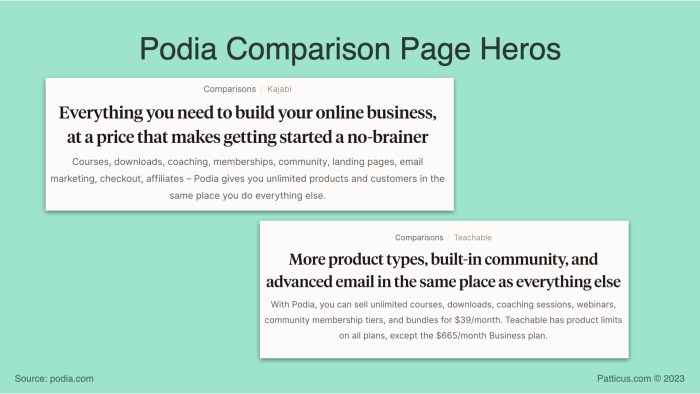
- Feature Comparison Tables
For most products it’s really hard for a customer to find a list of features let alone compare that list to that of a competitor. This is where product comparison tables come into play where you show the features you have versus those of a competitor.
These tables come in a lot of flavors – narrative comparison, tables with checkmarks, etc. You should highlight the differences between the two products and can curate what’s shown in the table. Personally I don’t trust these tables if they’re completely one sided, so you should make sure to highlight some things they have that’s not in your product. Yet, you can show some features that wouldn’t be necessary for the target customer (eg. certain types of support, enterprise features, etc).
- Solution Comparison
Features tell one part of the story, but the why someone uses your product versus another is even more critical. Slite handles this beautifully with this solution comparison table that frames the comparison to Notion as a choice between competing needs. On one hand there’s an endlessly customizable tool that needs training and dedicated resources. On the other hand there’s a purpose built tool that’s opinionated and intuitive.
Slite may lose deals because of this comparison page, but those deals were never good fits for Slite in the first place if they looked at this and thought Notion was better.
Your comparison page needs to go out of it’s way to frame the two worlds your potential customer is choosing between.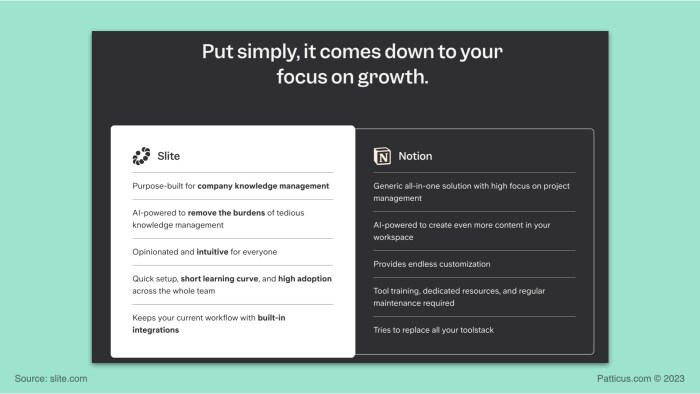
- Pricing Comparison
If you’re a cheaper solution than a competitor, it’s worth putting a pricing comparison table on your comparison page. A real gangster move would be doing it even if you’re more expensive and explaining why, but that’ll take more skill and I don’t want you to wait to publish these pages.
Brevo does a really good job comparing their pricing to Mailchimp (and their other competitors on different pages). No matter my size I can clearly see how my pricing would be different. This works especially well for products with unpredictable, usage based pricing.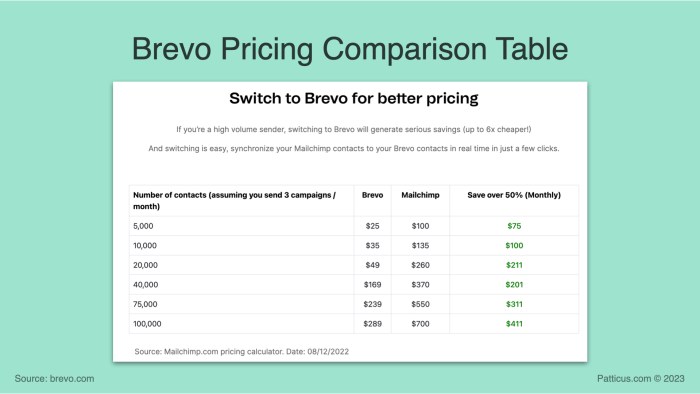
- Customer Satisfaction and Testimonials
When most customers are making a decision they aren’t actually looking to better themselves or their company. They’re looking to not make a bad decision that makes them look like they were wrong. This means the opinion of others weighs heavily. You can take advantage of their herd energy by highlighting what other customers have said about your product.
One way is to take review site data (which we already collected for you) and publishing a comparison like Brevo below. You should also include testimonials that specifically mention switching from the competitor to your solution. I’ve included some brilliant ones Intercom curate below, as well.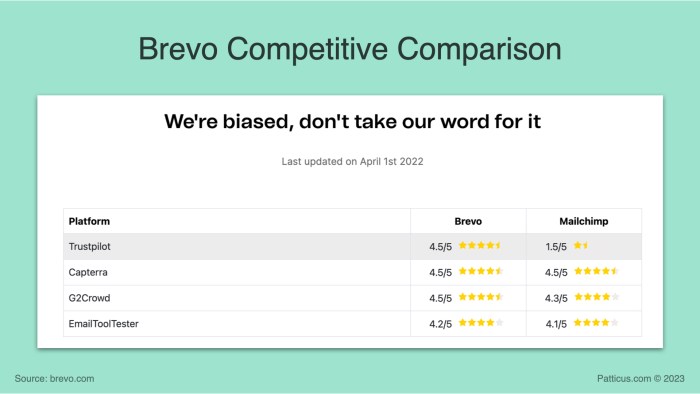
- Other Elements I recommend:
- Say something good about the competitor: It can be a backhanded compliment or something good about their features for a part of the market you don’t care about, but giving them a compliment will build trust.
- Performance comparisons: If your product has performance metrics (eg. accuracy, uptime, deliverability, etc), build a comparison table showing off the performance comparison. Builds a lot of trust and sows doubt in using the competitor.
- Migration services: We’ll talk about this in a bit, but if you have a migration service to help a customer move from your competitor to you (which you should), then make sure that’s on the page somewhere.
Playbook #2: Search – Organic and Paid Competitor Campaigns
Search is the highest intent means of finding things on the internet (at least for now). Even if most of your sales come through other channels, you need a solid organic and paid search competitive playbook. I’ve run these playbooks for the past decade and they’re the highest ROI efforts we ever did at ProfitWell. I know many companies who’ve said these did the same for them, too.
Paid Search Competitive Campaigns
Ever search for a company via Google instead of typing in the URL? Me too. All the time. In fact, this is how 10-35% of all traffic flows to a website – someone searches “ProfitWell” and clicks on a Google result rather than typing in “ProfitWell.com”.
This is an enormous opportunity.
While those customers certainly aren’t thinking of going to your website, Google gives us the opportunity to advertise on that intent. You should be using search ads that address a key gripe customers have with the competitor and then drive those customers to a custom landing page working to convert that customer with an offer for trying to make the switch (eg. free assessment, trial, call, etc).

Here’s an ad we used for our competitor Baremetrics. At the time people complained about their cost, so we leaned into our product being free. Most of the customers who saw this ad didn’t click, but the ones that did converted at an exceptionally high rate.
You’ll find these campaigns want be your highest volume, but they’ll have massive ROI, especially if you’re targeting aspects of the competitor product that frustrates customers.
Organic Search Competitive Campaigns
Similar to the paid search campaigns, using organic search competitive campaigns can be exceptionally high ROI. You’re likely not going to be able to compete with your competitors organic results, because their domain will have high authority (although I have seen folks start media sites on separate domains to fight this battle). Yet, you can certainly own the search results for alternatives.
A lot of customers or prospects will search your competitors name with the word “alternative”, “competitors”, et al. Use your favorite search tool to find the most common search terms for competitor alternatives and then set up landing pages that push that organic traffic to your comparison pages.
Playbook #3: Target Competitor Customer Lists
Your competitor’s customers don’t need to be educated about your market. This makes them an enormous opportunity, because you only need to educate them about you (and why you’re a better solution). To do that we’ll build out highly targeted campaigns by first identifying them and then targeting them in the right manner.
Identifying your competitor’s customers will depend on the type of product you’re selling. If you’re a B2B product, you’re already creating a list of competitive customers through the scraping being done through your intelligence monitoring. For consumer products, you care a bit less about individual testimonials on a website, because these’ll be individual consumers. Regardless of your business or consumer focus, here’s where I find competitive customers:
Here’s where I find competitor customers:
- Customer lists from intelligence monitoring: Just referenced this, but as a reminder, your assistant or team member is finding new logos from your competitor’s website, social feeds, and the like every month (or quarter) and adding them to your Competitor Dashboard.
- Firmographic products: A lot of products leave a trace on a companies website that tools can track. For instance, if you use Stripe, I can easily tell by going to your checkout page and looking at your site’s source code. Thankfully tools like Zoominfo, Clearbit, and Builtwith do this automatically, so they can give you a list of websites that use certain products. You can then take that lists and find your target customer who works there’s email to send the below campaigns.
- Conference Sponsors and Attendees: Industry conferences love to list out the companies attending or sponsoring. These logo lists are ripe for targeting.
- Forums and Reddit: Most popular products (especially consumer ones) end up with a user forum or subreddit full of conversations and support about the product.
- Meetups and communities: Similar to forums and subreddits, popular products will have meetups and communities spring up. Lists of attendees are sometimes widely available.
Once you’ve identified where your competitor customers frequent or an actual list of them, you’ll need to target them in the right way. The best targeting comes in two forms: 1. Competitor specific outbound campaigns, and 2. Highly targeted ad campaigns. You’ll need a good CMO or sales leader to parse out the details, but let’s walk through the nuances of both.
Presuming you have a list of actual customers of your competitor, the most efficient sales and marketing efforts come from competitor specific outbound campaigns. The details will depend on the value and nuances of your product, but the basic idea is you want to curate a campaign with the context that the target customer is already using a competitor.
Highly targeted ad campaigns work in the context of the above, but also especially for consumer products. Pushing ads that speak to the gripes with a competitor to targeted forums, communities, et al with their customers won’t necessarily be the highest volume campaigns you do, but they’ll be extremely effective. If you happen to have a list of users, doing highly targeted campaigns using Influ2, LinkedIn, Facebook, etc works wonders, as well.
Always keep in mind that a great competitive campaign of any kind implants doubt in the mind of the competitor customer before alleviating that doubt with your product. Depending on the strength of your competitors this can be tough. Yet like all sales and marketing, iterate and experiment.
Playbook #4: Sales and Marketing Competitor Battlecards
Your customers know alternatives to your product exist. If for some reason they don’t, they can easily find those alternatives. As potential customers progress through your marketing funnel or partake in sales calls you have an interesting choice – you can proactively bring up your competitors or you can react if they bring them up during the conversation. Instinctually you probably think you should be reactive, so we’ll talk about that first. Yet, there may be a much bigger advantage by being proactive.
If you choose to only handle competitor objections reactively, you need to make sure your sales and marketing teams are educated about your market. They need to know where you sit relative to the competition. They also need to know how your product compares. You already have all the research through your Market Command Matrix and monitoring research. Now you just need to operationalize it into objecting handling collateral.
For each competitor, create an internal slide that walks through how to speak about your competitors and how to handle any objections that concern them. You likely already have sales battle cards, but make sure they include:
- What type of customer tends to use the competitor
- Why you tend to lose deals to the competitor
- Why you tend to win deals to the competitor
- Common objections involving the competitor and how to handle them
Sales folks love a good talk track, so the more language you can give your sales team, the better. Someone in sales enablement should own these slides and improve them over time.
I recommend also creating slides that can be included in publicly facing sales decks that compare you to your competitors. Think of these as comparison pages, but for sales decks. If a prospect asks you about a competitor and you show a slide that’s incredibly researched, you’ll gain an enormous amount of trust.
The opportunity to build trust through your market research is the reason I think you should be more proactive with your research in the sales process. Your customer’s spending time research the market for the best solution. You already did that research. You know how all the players in the market stack up. So why not share that research with them in the sales process?
You have an opportunity to be their advisor. Position yourself as a market sage who understands the different solutions in the market and who succeeds most with each. Talk through their options and give them more research than they were going to do themselves. If they’re a good fit, they’ll feel like they don’t have to do any more research and go with your solution. If for some reason they’re not a good fit, you’ll have built so much good will they’ll be helpful in the future.
Based on what I’ve seen in the market this is where sales is going. At ProfitWell we called it “Advisory Driven Sales”, and it was wildly successful. We even took the strategy to the extreme and put links to our competitors on our pricing page (don’t worry, they were nofollow links ;)). If you want to go deeper on this strategy, I recommend reading April Dunford’s content (and books). Her new one goes much deeper on this strategy.
Ok. That wraps up the foundations.
If you set up comparison pages, search campaigns, paid customer targeting, and sales and marketing battle cards, your core is covered. Most of these won’t take long to implement either, especially since all the research is done. I told you we designed the system to bring you leverage. 🙂
Now you don’t have to do more than this to siphon a lot of revenue from your competitors. Of course, you can do much more, so let’s talk about some more aggressive competitor attacks next.
How to Attack Competitors (and which to target)
To understand how we’re going to attack your competitors, we need to think for a second about all the steps that take place when a customer purchases a product.
First they have some kind of need. Their boss could have asked them to find a product for X. In another scenario they’re super annoyed with how long Y takes, so they want to find a product to cure that irritation themselves. Maybe they’re just standing in a checkout line and the brightly colored candy sparks a hunger pang. No matter the decision, there’s always a need.
After the need comes research and consideration. For some products this phase takes months and involves dozens of people. For other products emotions could spark an impulse buy in a millisecond. No matter the length of the decision cycle, there’s always a period of contemplation.
Post decision there’s reflection. Was it the right decision? Do other people think it was the right decision? How is this decision going to impact me in the future? Do I regret it? Will people think less of me? Decisions always echo with residual feelings.
Understanding the purchase process reveals that the journey is littered with emotions. We try to bring logic into our research and consideration, but few decisions have an absolute right and absolute wrong (those ones typically involve body counts).
We bridge that lack of decision certainty with emotions that work to minimize as much regret as possible. Purchasing decisions become less about the product fulfilling a need and more about our identity. We don’t want to make a bad decision, because we don’t want to regret how it makes us look to our friends, family, team – or even our own self-image.
The specter of purchase regret makes stealing your competitor’s customers difficult. If they already regret using your competitor, they’ll find you through your standard marketing or foundational competitive playbooks. Yet, if they don’t regret using your competitor, there’s a lot of emotional inertia that needs to be overcome.
That inertia’s tough, but not insurmountable.
Each competitive playbook needs to exert enough pressure to make a customer doubt the use of your competitor while simultaneously positioning you as a salve for that doubt. Thankfully you have everything you need to utilize this principle. The research and intelligence you’ve gathered exposes exactly where your competitors are vulnerable from a customer perspective. We just need to operationalize that research.
All of the playbooks we’ll walk through center on these competitor vulnerabilities. They also lower the barrier to switching to your product. When you reposition your product as the clear choice to remove all doubt and make it easy to switch, you have a recipe for printing cash off the efforts of your competitors.
Pumped?
Me too.
Before we walk through each playbook, we need to get our research into a format that makes implementing these playbooks easier. We’re going to do that by filling out an Attack Vector Grid. Sounds intense, but the grid is simply a single document where you distill down the specific vulnerabilities and pressures points of each competitor. We built out a template for you in your Competitor Command Center.
The process to filling in your Attack Vector Grid is pretty straightforward. You’ll read through your Judgment Log and review your dashboard and profiles for each competitor. You’ll then fill out two sections:
- How the customer views the product Here’s where we’ll distill our research into the pain pressure points. You’ll answer:
- What are the top product weaknesses customers complain about?: Most playbooks use these as pressure points to get a customer to rethink using a competitor’s product.
- What are the top strengths customers herald them for?: We’ll need competitor customers to know we have these strengths, too (or in some cases can explain how our strength is different, but better). We’ll also work on taking away these strengths.
- What are things customers want that we solve (or could solve) that are afterthoughts to the competitor?: These expose different vectors of attack for our playbooks.
- How the competitor’s leadership team views the product As you build judgment on a company, it’s worth getting in the mind of your competitor’s leadership team. How they view the world is less important than how the customer views the world. Yet, their view is insanely valuable to playbooks that involve partnerships or considerations for how they’re going to react. People make up companies, and people are emotional beings with many amazing pressure points. We’ll theorize on these pressure points by answering:
- Which product features or company strengths do company leaders care about most?: Knowing what they think is the company’s strength allows you to threaten that strength (and cause a reaction) or align with that strength to partner.
- Which product features or weaknesses makes them feel insecure?: People act erratically when trying to minimize insecurity – they rush, spend money, etc. We want to use this energy to our advantage.
- Who are your joint enemies?: Everyone’s fearful of someone or something. The big dog in the market may fear the second place rival. The small competitor fears the big dog. Joint enemies give you an in for conversations and attacks.
You won’t be absolutely certain of the accuracy of what you put in your Attack Vector Grid. Yet, you don’t need to be precise. Doing your research and building your judgment exposes themes of vulnerability for each competitor. Those themes are enough to exploit across their customer base to increase revenue flow to you. As you see that revenue come in, you’ll adjust your playbooks based on performance data to increase the flow further.
Put more simply – don’t overthink your attack vectors. You’re not looking to be perfect, because you’ll iterate over time.
Once you have your attack grid all filled out, it’s finally time to pick your attack playbooks and align with your team on how to implement them effectively. Remember you have two types of competitors you’ll attack – those competitors in your Harvest and All Out Attack quadrants on your Market Command Matrix. Many of the playbooks overlap, but we’ll walk through the different nuances of using them for the different types of competitors.
Harvest: Playbooks for high mindshare, but low resource competitors

Competitors with high mindshare, but low resources are typically generic, wide solutions for the customer’s problem (eg. Excel) or incumbents who’ve given up spending considerable resources on the market.
Both scenarios make competitors in this part of the market the highest leverage ones to attack, because there’s so much room to sow doubt.
Competitors who don’t spend much on the market are typically ok with flat or declining growth. Yet, this doesn’t mean they don’t care about revenue. They likely just moved resources to another product or out of the business through distributions. They traded growth for margin. We can use their focus on profit as an opening for a partnership, because they care less about the long term relationship with a customer.
Customers in these markets usually don’t have high confidence in why they’re using the competitor. Plus, the competitor isn’t spending a lot of resources in reinforcing their value or innovating. The result’s a customer who likely uses the product, because they haven’t heard enough about a better solution (if at all) or they’re just entrenched with a product they think is “good enough.” Either way, their lack of confidence makes our job much easier.
With that context, let’s walk through our attack playbooks.
Playbook #5: Win-Win Partnerships
Forging a partnership with a competitor in the Harvest quadrant is one of the highest ROI playbooks you can run. They’ve got a bunch of customers using their product to solve a problem that you presumably solve much better. You’ve likely innovated beyond the incumbent or your product’s much more specific than their generic solution.
One issue though – the incentive for a partnership is obvious for you, but not for them. By definition they don’t care much about your space (or they’d be spending more resources there). Even then though, partnering with a competitor feels counterintuitive, especially if they suffer from “one day syndrome.” They’re not doing much in your market now, but “one day” they might, so partnering with you could be a big mistake.
They’ll likely never actually get deeper into (or back into) the space, but reality doesn’t matter. We encountered “one day” syndrome a lot with adjacent competitors in the financial analytics market. All of the billing and payments tools we plugged into had crappy analytics. Our product made their customers infinitely happier. Yet, they were still nervous to partner with us, because maybe “one day” they’ll build their own analytics. None of them ever did, but the thought was still something we had to overcome.
The secret to moving past the syndrome is to find the proper plane of partnership that aligns with their incentives. Typically that involves bringing them high margin, cheap revenue and giving them an advantageous out if they decide to jump back into the space. You’ll use the pressure points from your Attack Vector Grid to incept these ideas, and then provide a ton of value to get the partnership over the line.
There’s a lot more detail here, so I went deep in the deeper dive toggle below. Ultimately these competitive partnership can be a boon for your business. They take work. Yet, so does everything that brings exceptionally high ROI.
Deeper Dive: How to forge a deep partnership with a competitor
A great competitor partnership has the following elements:
- Find the proper partnership plane
Every competitor’s insecure about something or has some need that you can fill. Sometimes those insecurities and needs actually align with what customers think, too. Our goal with a partnership is to find the need or insecurity that we can salve, because it’ll serve as the pressure point we hammer to get to a partnership.
Go back to your Attack Vector Grid and look at what you thought through for the competitor. When dealing with partnerships, what the company’s leadership team thinks will hold more weight than what customers actually think. If they align, the next steps get a bit easier, but alignment isn’t necessary.
For a lot of competitors in our Harvest quadrant at ProfitWell, the leadership teams were insecure about Stripe, so they moved most of their go-to-market efforts to larger customers. Those larger customers had more feature needs though (a lot of them wanted analytics) and setting up their pricing was a barrier to them onboarding to the competitor’s product.
Those were two pressure points we could press hard, because two of our products solved those problems, so they formed the plane through which we’d partner.
A lot of times the pressure point can be much simpler though – money. If you have a way to directly help their top line (eg. revenue sharing, bringing them leads, etc), you may not need to think that hard. This works especially well for incumbents that have “given up” on your part of the market and moved on to other products. If you can slow their revenue decay or increase their revenue on this business line, they’ll do partnerships all day, every day. - Incept the idea – bring evidence
Once you’ve picked your pressure points, you need to incept the idea with the competitor. In an ideal world you want them coming to you to suggest the partnership, especially if they’re bigger than you.
To do this, the most effective point of attack are their customers. Deep partnerships always go through the product team at some point. Except, product folks kill them all the time, because business people see dollar signs while product people see you messing up their customer experience.
Yet, what if the customer demanded the partnership? Product folks are super sensitive to customer feedback, so if they’re suggesting some sort of partnership, Product will do the heavy lifting for you. Customers are the key.
We want joint customers (or potential ones) to pepper the competitor’s product team with requests for your product. There are a couple of ways to make this happen. A quicker way is to find a list of targets – folks in your marketing database that are customers of the competitor – and run a campaign asking them what they think about the competitor. Once they respond, I’ll then ask if they thought if we partnered with the competitor, that’d make their life easier. As they say yes, I’ll then tell them, “oh great. I’d love to help you with that. Could you do me a favor and email their product team something along the lines of….”.
It’s not your idea. It’s their idea. 8 out of 10 times they send the email.
As your competitor’s product team gets peppered with these requests you end up being more and more top of mind, which eventually leads to them reaching out. Ratcheting up this campaign simply involves scaling the process I just described to more people. You can create landing pages or sections of your product that when clicked suggest or help the customer send a message to the competitor.
The other point of attack I’ve found useful are investors and board members. These folks love to make deals, especially if they perceive a partnership increasing the value of the competitor.
For them we’re going to use a similar tack. We’ll ask the investor or board member for advice. On the call we’ll ask them a bunch of questions about how customers think about the market (that you and the competitor just so happen to be in).
Your questions should incept the idea that a partnership could actually be mutually beneficial without coming out and saying that specifically. Get them to suggest talking to the competitor’s executive team. When do, play dumb. Ask them, “I don’t know. I’m not sure they’d be interested. What do you think?” If the partnership actually makes sense and you’ve done your job right, the investor will now act as a champion for you. They’ll make the introduction and act as a backchannel source as talks progress.
You can run both of these plays at the same time, or think of other ones. The point is you want them coming to you or at least thinking of you if you see an opportune time to reach out. This’ll make everything infinitely easier. - Provide value – use content as a bridge
A worthy partnership takes time and there’ll be a lot of doubt around if it can actually work. To curb this, you should provide a ton of value as you’re incepting the partnership idea or actively working towards that partnership.
Sales and marketing’s a beautiful medium to provide value. As your conversations progress, every competitor still has a quota. Doing joint webinars, events, blog posts, etc. helps with that quota by bringing them more leadflow, especially along the pressure points they’re worried about that you solve for them.
There are other ways to provide value – introductions, feedback, etc. The point is to be seen as someone who can help their business along the lines of something they’re insecure about.
You’re also trying to stay top of mind. You won’t be their top priority, so continuing to partner on sales and marketing (or another value track) keeps you in the mix. It also builds you a lot of good will and allies internally. - The approach – make partnering easy
Assuming you’ve incepted the idea and provided value, you now need to make the approach for the actual partnership. I highly prefer making the partnership their idea, because that energy is infinitely easier to work with than you trying to push for something. Yet, we don’t always have that choice.
Once there’s an opening, as them how they think a partnership would work. If all goes amazingly, what’s a major win for them? What problems do we need to avoid? What are they worried about?
As they answer these questions you’ll start making your approach. I typically find getting them excited about the grand partnership vision and then suggesting a very small start works very well. It also requires the least amount of people to get involved. The proof of concept will depend on your product and market, but start with an integration, marketing campaign, or some effort that gets you mixing your logos and revenue.
You’ll then run the conversation like a sales process. Ask them about barriers, who needs to be involved, what success looks like, etc. You then have a roadmap for getting things done.
Your ease of working together will be super important, too. Offer to do most of the work on your end for an integration. Remember, the gains are more obvious for you than them. Doing the above groundwork helps reframe a potential partnership considerably, but them getting these gains for minimal work makes the partnership seem even more appealing.
There will be objections you need to handle as more folks get involved, especially on the “one day” syndrome we talked about earlier. Telling them we can cross that bridge when we get there and we’re more than happy to unravel the partnership if it makes sense tends to calm their nerves.
Use your best judgment though. Sometimes they’ll be concerned about actual competing features. We had a Revenue Recognition product that competed directly with some of the competitors we were trying to partner with in the above manner. I joked with each that, “we just won’t talk about that piece,” but you’ll likely have to come up with talk tracks for these objections.
The point is to make it easy and there are a lot of axes to play with to ease into a partnership. - Make the initial partnership successful and expand
Once you get buy-in for an initial partnership, you need to go all in on making it wildly successful. Do things that don’t scale. Beginnings are precious, and you want to be undeniable.
Assuming you succeed, you’ll then work on expanding the partnership to something long term. There are a lot of deeper guides on partnerships at this stage, so I won’t go deep. Yet, keep in mind that these take effort and at this point you should have a team member dedicated to curating the partnership (or a few) full time. Given the number of customers you could potentially gain from harvesting the competitor, hiring this person should be a no-brainer.
Playbook #6: Mini-Product
Sometimes competitors you want to harvest customers from aren’t viable for partnerships. This is typically because they’re too big or generic – eg. Excel. If your competitor falls into this category or just doesn’t want to partner, the most effective playbook is using a mini-product.
A mini-product creates a solution that’s solely targeted on an insecurity or need you identified in your Attack Vector Grid. The goal of a mini-product is to provide an on ramp to a relationship with the customer. You then parlay the satisfaction they gain from the mini-product solving one of their problems into a sales conversion for your full fledged product. These can be as simple as online calculators or excel workbooks or as complicated as full products. Ideally they set up your full fledged product in some way, but it doesn’t need to be complicated.
When building ProfitWell, we wanted to siphon more customers from HubSpot and Salesforce reporting to our financial analytics product. These competitors weren’t going to partner with us, because we were way too small for them, but we knew a really big pain point for customers was getting revenue data into these products.
To siphon customers we created a mini-product called RevConnect that cleaned and ported revenue data into Hubspot or Salesforce. A requirement of signing up for RevConnect was creating a ProfitWell account, which we then used to slowly get customers to use our financial analytics and other paid products.
Your mini-product is a trojan horse. Often times that horse ends up being win-win-win for everyone, but the whole point is to mix the need of the customer with the anxiety of the competitor. Once they’ve signed up, you have their email address and can nurture them to whatever aim you seek.
Playbook #7: Full Integration
Open platforms are brilliant for harvesting competitor customers, because you can build an integration directly with their product. The integration makes migrating to your product much easier. It also pushes your competitor to advertise your solution for you, because you’ll be listed in their app store, integration pages, etc.
Make sure the integration goes well beyond simply hooking up the pipes though. You need an actual sales and marketing strategy that drives people to use the integration and then nurtures them once they’re hooked up. They should receive competitor specific marketing copy. It doesn’t necessarily need to mention the competitor, but should push on the right pressure points. Onboarding these folks should be different, too. Their needs and context are different.
There’ll always be some risk of a competitor shutting your integration down, but most companies in this quadrant want to stay neutral or don’t care about your space much (or they’d be spending more resources on it). Even if they do attack back in some manner, we’ll have playbooks for using that energy to your advantage. More on that in the defense section below.
Playbook #8: Migration Services and Products
Inertia is one hell of a barrier to you siphoning customers from competitors. You need to make transitioning to your product incredibly easy with migration services and products.
Each competitor is different, but if you talk to enough of their customers, you’ll get a glimpse into what they’re concerned about when thinking about transitioning to your product. You may be missing a features, but more often than not it’s things like not losing data continuity or how their information is organized when they switch. Talk to them and find all the objections and then squash them one by one through manual or automated transition services.
Notion does this brilliantly in an automated way with competitors like Evernote. With a couple of clicks and settings, someone can seamlessly transition to notion with all their notes and data imported.

Sometimes you can’t fully automate the transition though, so don’t be afraid of going manual. Convertkit does this well and built out a whole services playbook for doing the transition for their prospects that want to port over to them. Given their lifetime value, it’s well worth it, even if some of the folks they migrate aren’t that big.

Other times you’ll need to do heavier lifting. We didn’t end up doing this before we sold, but we ended up getting a lot of feedback from Baremetrics customers that they didn’t want to use ProfitWell, because they really liked the core Baremetrics analytics dashboard. We weren’t going to change our core metrics dashboard, but we had mockups for created a “Baremetrics” mode where a user could click a toggle and see the dashboard in the exact same way Baremetrics presented their dashboard.
We wouldn’t have called it “Baremetrics mode”, but that’s why we would have built it out. We didn’t end up doing this because we were siphoning enough customers from them that the payoff didn’t seem worth the effort. Yet, you may have to consider changes this extreme.
The point – don’t let the fear of losing function prevent customers from transitioning to your product. Make it easy.
Playbook #9: Ad Campaigns
For all competitors, but especially competitors in the Harvest section, targeted advertising campaigns should be at the top of your priority list. We’ve already went through the basic ad campaigns you should be running in the foundations section. Yet, more substantive ad campaigns can siphon loads of customers when done right.
We won’t go through all the principles of advertising here (hire good marketers), but you want to put pressure on the weaknesses and insecurities from the Attack Vector Grid via your ads. Your campaigns should be highly targeted to these pressure points, but don’t necessarily need to mention the competitor.
Dove’s “deserve better” campaign doesn’t even mention their competitors, but points out the weakness of some customers believing the competitors are too harsh. Even if you weren’t thinking that, you are after seeing their ad.

Sometimes you want to straight up compare yourself with the competitor while dialing in on an insecurity. Here’s a good example from Bud Light. They took the anxiety people have around corn syrup (something I doubt they ever associated with a beer) and combined it with one of their rivals.

Your goal is to sow enough doubt that a customer reconsiders their allegiance to a competitor. A proper CMO and/or sales leader will make this part of a wider campaign that could include paid media, content, sales funnels, events, et al. Yet, focus on action instead of perfection.
Most executives are too scared to run campaigns like these, because they think it “looks bad.” It only looks bad if you lie, so don’t do that. Remember, people know alternatives exist. There’s absolutely nothing wrong with highlighting your alternative and why it may be better.
Playbook #10: Contract Buyouts
You never want a contract to be a barrier to switching to your product. Yet, if you solve the issue of easily migrating to your product, the number one objection you’ll receive is, “we’re in a contract for another X months”, especially for subscription products. Rather than waiting for the customer’s contract to expire (and hoping they remember you when it does), you need a system for buying out these contracts.
The way contract buyouts work is you find out how long is left on their agreement and then give the customer that amount of time for free, assuming they sign up for a contract that goes beyond that length. This works amazingly well for consumer and B2B products.
How aggressive you get with these buyouts is largely dependent on your product’s lifetime value. Yet, I wouldn’t be stingy. Most of the time the customer acquisition costs for these customers ends up being low, because you don’t need to educate them. This means you likely have more room for buyouts than you think.
Implementation largely depends on the skill of your sales and marketing teams. For products that are more self-serve, you’ll need to create a program with ads, landing pages, offers – the works. Give the offer a name and a brand. A great example is the T-Mobile “Phone Freedom” campaign where they’d buy out a competitor’s contract if you switched to them.
For products that involve a sales process, create a similar program, but make sure to train your sales team. You don’t want them leading with the offer when a lot of customers will switch on the merits of your product. You want them using the offer only when an objection comes up.
Ultimately attack playbooks come down to sowing doubt in the customer’s decision to use a competitor and providing an easy path to move to your product. For competitors in the Harvest quadrant, these are some of the easiest playbooks to run, because competitors are mostly absent and won’t fight back. They’re extremely high ROI though, so make sure to put in the work.
We’ll use a lot of the same playbooks for competitors in the All Out Attack quadrant, but our approach will shift. These competitors have more resources, so we need to attack wisely.
All Out Attack: Playbooks for high mindshare, but high resource competitors

For the competitors in the All Out Attack quadrant we’re going to use our same first principles of sowing doubt and making transitioning to our product easy. Yet, we’re also going to dial up attacks that remove a competitor’s strength.
Why is that important?
With competitors in the Harvest quadrant you’re dealing with executive teams that don’t care about your space much. They’ve got other priorities, so when you “attack” them, they may get annoyed, but most of the time they’ll ignore you.
Competitors in the All Out Attack quadrant are very different. They care a lot about your market and see you as a threat. Sure, they’ll tell you “the market’s big enough for everyone”, but anyone who actually acts like that’s true is either naive or lying. Their position means they’ll attack you and react to your attacks.
Running our standard playbooks will get results. Yet, we also want to remove their strengths, because doing so uses their resources to move the market away from them and towards you. If everyone uses a market leader because of their support, I want to make my support so phenomenal, customers think support’s table stakes. I’ll then find a differentiator the market leading competitor can’t easily compete with and hammer it so customers start to demand it of everyone. They’ll then see me as the market leader.
Put more succinctly – to become the market leader, the market needs to value your strengths above anyone else’s. Removing the strengths of competitors in front of you is the quickest path to make that happen.
This playbook’s known as the Wedge Strategy. We’ll go through it in-depth, but let’s first walk through the other All Out Attack playbooks first, including how to modify the playbooks we already learned.
Core All Out Attack Playbook Modifications
All of the playbooks we discussed for competitors in the Harvest quadrant should be used for your All Out Attack competitors. You’ll just modify them slightly to take into account that these competitors have more resources and see you as a threat.
Use the deeper dive toggle below to walk through the modifications.
Deeper Dive: How to modify the Harvest Playbooks for the All Out Attack competitors
- Playbook #5 – Win-Win Partnerships
Yes – you can partner with competitors sitting in the All Out Attack quadrant. It’s an order of magnitude more difficult. It’s also best done if your company is newer to the market and perceived as different than the competitor.
With these types of partnerships, one plane of partnering I like to subtly suggest is that working together’s a part of an M&A discussion. After all, “we should work together to see how the products and team’s mesh.”
Tread lightly and use the pressure points you’ve documented in your Attack Vector Grid wisely. Typically the best way in to a partnership is to target a specific feature set they’re weak in – ie. we’ll help your customers with our pricing product, which you don’t have in your current suite. The other great way to partner is targeting a location the competitor is weak in, but wants to get better (eg. you’ll help them do more in the US or Europe). These partnerships are difficult to make happen, but like all things that require effort, there’s an enormous payoff when you get them to work. - Playbook #6: Mini-Product
Running a mini-product playbook works the exact same way with these competitors. The only modification is to keep in mind that the competitor may respond by shutting your access to their APIs down if your mini-product utilizes a direct integration with them. Sometimes this is the best thing to happen, because you can cause a public crapstorm to gain a ton of support (more on how to do that later).
If they’re bigger than you, position yourself as being a big fan and just trying to fill a gap they haven’t filled yet. This’ll buy you a ton of time before they catch on. If you’re bigger, I wouldn’t associate the mini-product with the competitor specifically (ie. “the COMPETITOR NAME tool”). It’s simply a tool for the community – that just so happens to be really good at getting the competitor’s customers to convert to your product. - Playbook #7: Full Integration
Similar to the mini-product you run the risk of being shut out of someone’s product (although this is a big gain in terms of PR if it does happen). All the same logic from above applies, but just be ready with some of the defenses we’ll talk about below in case this does happen. - Playbook #8: Migration Services and Product
Migration services and products are even more critical for competitors in the All Out Attack quadrant. You may need a whole team dedicated to migrating competitor customers, especially if you’ve built a product that integrates with them and they mess with it’s connections to your product.
As an example, billing systems make it notoriously difficult for a customer to leave. Most just give you a CSV and won’t help with your data, transitioning your customers credit cards, or really anything.
A migration team does wonders in these situations. They’ll do custom services or build custom software to make it easy. Most of the time though, you can build migration software that’s pretty robust and will work even if a competitor messes with you. - Playbook #9: Ad Campaigns
The type of Ad Campaigns you run when attacking an All Out Attack competitor can be a lot more aggressive than those of a competitor that cares less about your market. The comparison ads we walked through can do wonders, assuming you can back up your claims.
Two key themes typically work for these ads – being subversive and being fresh.
Subversive ads sow tons of doubt in the mind of a customer, because they fear they’ve made the wrong decision when you expose that you’re better. Ads that come off fresh or cool tap into the “new” gene that a lot of people have when they think about buying software or products. People want to keep up with others. You can be the thing that they need to keep up.
Ultimately, make sure you build these campaigns with proper marketing and brand leadership or they can go poorly really quickly. You’re threading a needle very publicly. When done right, it’s a huge win for your business. When done wrong, it can damage your reputation. - Playbook #10: Contract Buyouts
Buying out your competitor contracts works very similarly with All Out Attack competitors. I’d be a bit more aggressive with these competitors though, because they’re investing a lot into the customer relationship and product. This means it’ll be harder to get a customer to move to you.
Additional All Out Attack Playbooks
Playbook #11: Offer Guarantees
Finding a way to guarantee success with your product works wonders for a lot of reasons. Yet, when dealing with a customer using a competitor, it’s one of the primary ways to make the decision to switch seem like a no brainer. If you don’t offer some sort of satisfaction or performance guarantee in general, you should at least offer one through your marketing or sales teams for customers moving from these competitors. The inertia is just that much higher and requires more oomph to unblock.
When building ProfitWell, our Retain product that lowered cancellations for subscription companies had the luxury of being able to track exactly how much money we were making our customers. For those customers on competitive products, we’d tell them that the product would be completely free for however much our competitor was making them. After that amount was where our pricing would kick in. The pricing model was “no-brainer” in general, but pairing this with the discussion of how we compare to a competitor really pushed them to convert to us.
If you don’t have the ability to price on some sort of performance, general offers can work, as well. Give them 3-month outs for annual contracts, a money-back guarantee, or even offer up different add-ons for converting.
Typically customers are simply looking for a sweetener that calms their anxiety enough to make the decision feel hedged. You’ve presumably already sowed enough doubt in the competitor customer through your sales and marketing process. The offer just makes them feel like they’re gaining even more.
Playbook #12: Competitor Sales Incentives
Assuming your product has a sales team, they’re an amazing army for battling competitors. The best part about a sales team is sales compensation and their monastic alignment with all things incentives. If you ever need to clean up something sales folks are doing wrong or get them to do something, the first change you should make is sales compensation. You’ll always see a change in behavior quicker than anticipated.
When it comes to competitors, you can give the sales team an extra push by providing a kicker for when they close a customer who was using a competitor. You may be thinking – isn’t their sales commission already enough? Maybe, but they’re getting that with all their leads.
I want them to be as dialed in as humanly possible when they’re talking to a customer who’s with a competitor. The easiest way to make that happen is to tell them if they convert a customer from a competitor it’s worth an extra 10-25% of bonus or quota attainment on that deal. Magically, your close rates will be highest for these prospects coming from competitors.
Obviously this is good for your revenue and growth, but it’s also bad for your competitor. You’re not only gaining, but they’re losing. In the battle for market share, you don’t have a ton of time or resources to worry about anything beyond you gaining. Yet, if you can run a playbook that makes you gain and pushes them to lose, you should run that playbook all day, every day.
With all of these playbooks, make sure you keep coming back to your Attack Vector Grid and your research. Every playbook should be sowing doubt in the customers’ decision to use the competitor or making it easy to switch to you. Ideally, they do both.
Those are the first principles of competitive playbooks, and I’ll keep saying them until the cows come home. They’re everything.
If you run the above playbooks (heck, even just the foundational ones), you’ll do exceptionally well. You’ll gain lots of customers from your competitors. You’ll defend yourself from their attacks, too. Yet, if we want to be the best in the market, we need to deploy a Wedge Strategy.
Let’s jam on that next.
Playbook #13: A Competitive Wedge Strategy
The biggest misconception in any market is that the biggest dog on the block gets to set the terms about what the market cares about, how people view the market, and where the market’s headed. This is a big crock of crap. It doesn’t even make sense.
Customers and value dictate the direction of a market.
They’re the ones buying what you’re selling and if someone ends up selling something better than you, they’ll slowly or quickly (depending on the market) move away from you to them. This is scary because it means you’re susceptible to disruption. Yet, so are your competitors. Unlike you though, most competitors are pretty lazy.
They don’t talk to customers.
They don’t do the research.
They don’t have a strategy.
Instead, they buy their portion of the market by throwing stuff up against the wall and inefficiently repeating what sticks. We can capitalize on that laziness. By maniacally focusing on your market’s customer (as we’ve done already in our research) we have an opportunity to wedge the market and jump ahead as the market leader. You’ll be a hero. Your company will do massively well. Everyone will get paid.
The Wedge Strategy works by you exerting intense pressure on an area where your competitor’s weak and insecure. You then make that area your strength, and a major part of your entire identity. When done right, even if you don’t have their revenue or resources, you’ll put so much pressure on the market, you’ll become the market leader, because you’ll the one with the strength demanded by your market – your wedge.
There’s a ton of power in the Wedge Strategy, so let’s walk through how to pick your wedge. We’ll then go in-depth on how to force your wedge on the market with so much pressure your competitors have no choice except adopting your wedge.
Finding your wedge
A great wedge is simple enough to be understood by customers, but valuable enough that over time they demand it from the product they’re using. A wedge is typically aligned very closely with the principles through which you build your product. That’s a bit hard to understand, so let’s walk through an example.
We used the Wedge Strategy relatively well with our financial metrics product. We won the market, but in the beginning we were dead last. All of our competitors were shipping features constantly with bigger teams and more funding than our bootstrapped, little pirate ship.
Through customer and competitive research we found our wedge though. We discovered that competitor customers always complained about the same thing – the accuracy of our competitor’s financial metrics.
Unlike marketing metrics, if I tell you that you should have $1.1M in your bank account, you should have $1.1M in your bank account. Our competitors (and us at the time) did not have this accuracy. Since we were all weak, but the value of accuracy was so fundamental to the product we were all producing it became a great candidate for a wedge.
Accuracy also has the unique quality of taking a lot of effort to achieve. Every company implements their billing software a bit differently, so while not difficult, getting a product to accurately spit out metrics for all these implementations would take a long time. We estimated making just our Stripe Billing integration accurate would take 6 months. Really it took 18 months. We also had six other billing integrations.
A good wedge has at least a small technical barrier, because it provides just enough friction to prevent your competitor from quickly fixing the issue.
At the time the friction to perfect accuracy pushed our competitors to build new features in lieu of fixing their numbers. Prioritizing product development and engineering resources is not a small endeavor. Most product leaders are above average in arrogance (it’s a trait that makes them good). This is a huge advantage, because if they’re prioritizing everything, but the wedge you choose, they’ll think you’re making a mistake. Little do they know, you’re developing your wedge from customer inputs.
The combination of accuracy being of fundamental value to the product, a low priority to our competitor product teams, and having a technical barrier made it a perfect wedge.

Your wedge should stem from these three axes. The first place you should look for possible wedges is your Attack Vector Grid and research. There’ll be loads of ideas and insights there to start the process of finding your ideal wedge.
Keep in mind your wedge doesn’t need to be something you’re already good at or focused on (we definitely weren’t focused on accuracy). It just needs to check those three boxes. The more your wedge aligns with them, the easier it’ll be moving the market to prioritize your wedge and leapfrog you to market leadership.
Forcing your wedge on the market
Once you find your wedge, you need to force it on the market. Your goal is for no conversation about your market to take place without addressing your wedge. This requires your wedge to be easy enough to understand, at least in terms of the wedge’s value. There’s nothing worse than picking a wedge that requires five layers of explaining to understand why it’s important.
Stop trying to make fetch happen.
If you find yourself with a wedge where people don’t understand it’s value without explanation, go back to the previous section, your Attack Vector Grid, and start over. If you have a good one, keep reading.
You also need to talk about your wedge – constantly. Every blog post. Every sales message. Every interview. Make it top of mind for your customers and market influencers. Doing this is actually pretty straightforward, but you need extreme message discipline and to attack two axes:
1. Sow doubt with customers
If you haven’t caught on by now, customers are the bedrock of making things happen in your market. Forcing your wedge to become top of mind is no different. To use our customers, we’re going to incept them into thinking the biggest thing they should care about is our wedge.
A few tactics make this happen:
- Wedge Sales and Marketing Campaigns: Our core and competitive marketing campaigns need to put our wedge at their center. Our goal is to get our target customers to question if their current solution is good enough, because it doesn’t have or doesn’t live up to the wedge we’re pushing in the market. We made accuracy a part of every ad, every pitch deck, and every sales email. We talked about it until a prospect told us, “we get it, you’re accurate.”
- Mini-tools that highlight your wedge: Depending on the type of wedge you’ve chosen, build out tools to highlight what the customer is missing by not using your product that contains the wedge. These make amazing middle of the funnel offers, too. Drift built free calculators that showed how much revenue Intercom users were missing by not having their “conversational marketing” wedge. At ProfitWell we offered free “Accuracy Audits” where we’d prove just how accurate we were compared to their current solution. Both sow the right type of doubt to have a conversation that brings a competitor customer to your product.
- Content machining: Publishing content that leads to your wedge in some shape or form can be extremely valuable, especially if your content is good. With content you’re trying to build up an army of acolytes over time that preach your wedge. Take this guide for example. I know very few people are going to reach this sentence. This damn thing is already 25k words. Yet, I do know that if you do reach this point, we vibe hard with one another. That vibe leads to you recommending this guide when someone mentions competitor intelligence and strategy, which invariably leads the way I see conducting that strategy being advocated.
2. Convince market influencers to take your wedge seriously
Your other axes of forcing your wedge on the market is using market influencers. Every market has them. They may not be Hollywood celebrities, but search YouTube or TikTok for whatever industry you’re in and I guarantee you’ll find creators with big followings geared towards your audience. There are also what I call “notables”. These aren’t necessarily creators, but their voices carry a lot of weight for customers.
To use these influencers we’re going to implement:
- Influencer Marketing: Who your influencers are and where they frequent will differ depending on your market. Yet, these folks are the perfect target for influencer campaigns that push your wedge into the market. They’ll do reviews, joint marketing, interviews, etc. – all of which can highlight your wedge and why it’s important. We ran a founder marketing playbook where I’d give talks, get interviewed on podcasts, and create content where I’d always mention accuracy on some level. We’d also go overboard proving our accuracy to any “influencers” that mentioned our competitor’s lack of accuracy or used our products. We wanted them to know the problem with them and the strength of us. This eagerness lead to plenty of public comments about accuracy, and many of those comments included mentioning us.
- Industry Reports: Similar to influencer marketing, a good number of industries have reports that buyers pay attention to before making a purchase. Some of these are analyst reports like Gartner, G2, Forrester, et al. Others are more consumer reports. You need to push your wedge in the conversations with these analysts. At the very least it’ll lead to them including your wedge as a primary category to compare companies in your industry. That’s insanely valuable for you, even if you end up not being the “best” company they recommend when they publish the report. You’ve changed the narrative though, and over time you’ll improve on your wedge and continue to hammer it’s importance.
With all of the above, you’re creating as many touch points as possible with high leverage activities to put your wedge front and center in the market. If you stay disciplined and don’t shift your message, people in the market will start to do the work for you.
Doubling down on your wedge
Message discipling will be the hardest part of your Wedge Strategy. It’ll take time, and when you get bored or don’t see immediate results, you’ll start to doubt.
Yet, at this moment, you need to double down.
Hammer the wedge constantly. Every interview. Every sales conversation. Every campaign. Just keep hammering. Depending on your resources and reach, moving a market takes a minimum of 9 months and up to 2-3 years.
That seems like a lot of time, but keep in mind what you’re doing. As you grow and stay on message, you’re slowly making the market all about your wedge. That takes time.
The sign you’ve succeeded is when your competitors start to fight back and address your wedge through their sales and marketing. This means you’re starting to hurt them, and customers are starting to ask them about the wedge.
They’ll start small with landing pages and a few ads. Yet, over time if you keep hammering, they’ll move more and more resources to address the wedge via their messaging and product roadmap. When you see this happen, double down with everything you have in the tank. You want to use that energy to solidify the wedge. Make them feel like your wedge is all the market thinks about.
At this point something magical happens. The market becomes about the wedge, because you and all your competitors start to put your resources behind talking about the wedge and making sure products utilize the wedge. Except you’ve been working on wedge for 1-3 years, so all of a sudden you’re in front. Your product’s perceived to always been about the wedge.
By definition everyone else is behind, because they’re not just taking the wedge seriously. They’ve also just lost their strength, because they moved resources from what was working to account for the wedge and those resources have to come from somewhere. The naturally weaken and while they may have a ton of resources, you’re now in the mix as a leader in the space.
That’s the entire ballgame folks.
Your position as a leader in the market becomes a self-fulfilling prohecy, because assuming you continue to invest, you’ll always remain ahead of them on the wedge. Remember – most companies are lazy. They’re highly distractable and follow more than they lead. As you evolve your wedge into perpetuity, they’ll continue to follow as long as you don’t let up.
Your Wedge Strategy and so many of these playbooks you’ll use to attack competitors come down to continually hammering the messages. It takes discipline, but most discipline is easier when you have confidence in your convictions. That confidence comes through your research, which builds your judgement, so don’t ever let up monitoring your market as your playbooks progress.
How to Defend from an Attacking Competitor
Most competitors won’t attack you, because of a level of self-righteous indignation. They’ll say things like, “the space is big enough for all of us” or “let’s focus on our customer”. These are limiting beliefs. They mostly stem from a lack of understanding of how customers thinks. We’re already using this ignorance to our advantage with everything you’ve read up until this point.
Yet, what we do when competitors do attack? What if they read this guide and are using these tactics against you?
If your space is worth enough, you’ll have competitors who fight back. Even if your space isn’t, when you make their world hurt, some folks will react erratically and punch back. We need a plan to defend against these attacks.
The tactics you’ll use for defensive playbooks are the same as the ones you use to attack – ads, sales, product, etc. Yet, your philosophy of how you use these tactics differs greatly.
For instance, if a smaller competitor attacks you, you may not want to give them oxygen by responding. Conversely if you’re much smaller and a bigger competitor attacks you, you want to use their size to your advantage by playing the victim.
There are three defense philosophies. Which one you use depends on your proximity to the attacking competitor.
Above the Fray: If the competitor has much less mindshare than you

If you’re attacked by someone with much less mindshare than you (they’re in the Monitor or Ignore quadrant of your Master Command Matrix), stay above the fray and do not give them oxygen by publicly responding to them. Launching a counter attack will elevate them in the market and give credence to their attack.
You’ll still respond, but your response will be by continuing to track them and doing anything to hedge against their damage.
For instance, after our financial analytics product was the market leader, one of our competitor’s publicly said we were lying and being unethical. He did this several times. After each time, I’d send him a lengthy email telling him I’d be more than happy to chat 1:1 and work through any questions to explain why we were saying what we were saying.
He never responded, and I never expected a response. I sent the emails because I wanted the paper trail. If he continued to cause more and more of a stink publicly, I had a record that I was being reasonable and coming to the table.
When he made a particularly big outburst, I then publicly responded to him and explained I’ve emailed him several times without response and I’ve always been willing to talk. Even if any of his assertions were right, staying above the fray made him look unreasonable. That was the last time he attacked.
Defending from a much smaller attacker can be frustrating, because you shouldn’t do much except track them. Keep any conversations private and use your judgement if anything gets out of hand. Always stay above the fray though and don’t join them in the mud. That only benefits them.
All Out Counterattack: If the competitor has similar mindshare as you

If you’re fielding attacks from someone with similar mindshare as you (they’re close to you on the Market Command Matrix), then you’re likely already launching attacks at them. Your customers are likely aware of both of you, and they come up in sales calls and support tickets. You’ll have to continue to attack them until one of you wins.
Your tools of attack will be all the playbooks we’ve discussed, but an additional tool at your disposal is your legal team. I’m not a fan of patent trolling a competitor or throwing frivolous lawsuits at them. Yet, if the stakes are high enough, a lot of competitors will likely stretch the truth in their attacks. Their comparison pages will say you don’t have things you do. Their marketing copy may mischaracterize your performance.
When a competitor is saying something incorrect about you or your product, you should use counsel to ask them to fix the mistakes. You don’t need to send them full legal letters out of the gate. I’d start with an email that simply CCs your counsel and asks them to make the changes. If they don’t, you can escalate from there. They’re educating the market just as much as you. You don’t want them educating the market incorrectly about you. These efforts will also slow them down a bit.
Most of your counter attacks will be through product and marketing though. In a lot of these situations companies will try to talk about the competitor without mentioning their name. As you may have guessed, I think that’s dumb. Customers know who you’re talking about, so don’t be condescending to them. Lean into it. Your customers will appreciate the honesty.
Avis nailed the counter attack strategy in the rental car market with their “we’re #2” marketing campaign. All of their ads talked about their position in the market and how that made them “try harder” against Hertz.
Attacks can be tough to deal with and they can make a market pretty bloody. Yet, anything worth doing will have more than one person trying to win. Your job is to make sure you’re the won who’s victorious.
Play the Victim: If the competitor has far more mindshare than you

When a much larger competitor is attacking you, the best strategy is to play the victim. You can’t look helpless, but you want to make the big, bad competitor look unreasonable. Sometimes the competitor makes this easier by actually doing something unreasonable that hurts customers in the market (eg. anti-competitive practices). Yet, even when they’re simply attacking you with marketing, you still want to use their energy against them.
No one likes a bully, so when launching your counter attack the best tactics involve rallying your customers or the public to be on your side. Traditional and social media work wonders here. Keep in mind we’re not necessarily trying to have a debate about the merits of what they’re saying. We’re trying to make the competitor look unreasonable and apply pressure. That pressure gets them to stop the practice, but also moves customers to your product as people rethink using the competitor. Humans don’t like to be associated with a bully.
Pillpack ran this playbook beautifully. They’re a delivery based pharmacy that sold to Amazon, but were about to be shut down when one of their competitors limited their access to drugs they could dispense (there’s more nuance, but that’s the gist). Could the competitor legally do this? Maybe. Yet, they didn’t focus on that part of the debate. They rallied their customers to contact key people and speak out publicly. The groundswell of support put enough pressure on the competitor to relent.
Competitors like to use their size and strength to bully a win into the market. Like all bullies you need to fight back. Most will back down relatively quickly if you turn their customers and community against them.
Always Cuddle with the Chaos
If you made it this far, we can be friends. It’s a lot of information, but I know it’s valuable, because I’ve seen it in action. Running your competitive intelligence program will take effort, but that effort will pale in comparison to the revenue and confidence you’ll gain.
It’ll get chaotic at times, but that’s what business is – chaos. Your job’s to cuddle with that chaos. It’s the only way to win. 🙂